Trans Kalahari Railway Construction Must Start as Soon as Possible

The proposed construction timetable places renewed attention on the outstanding decisions needed to move the Trans Kalahari Railway from feasibility into implementation. While the two governments have expressed their intention to accelerate the project, agreement on financing mechanisms, procurement arrangements and the appointment of a developer remains essential. The proposed public-private partnership model will also require clarity on the allocation of investment and project delivery responsibilities.

For Botswana, the railway would provide an additional freight connection to the Atlantic coast, supporting mineral exports and access to international markets. The discussions with Dangote Group also indicate potential opportunities for construction material suppliers and other industrial participants, although these remain prospective rather than confirmed procurement or supply contracts.

Trans Kalahari Railway Construction Must Start as Soon as Possible
Dangote Group chief executive Aliko Dangote, left, meets Botswana President Duma Boko. Photo credit: Duma Gideon Boko/Facebook

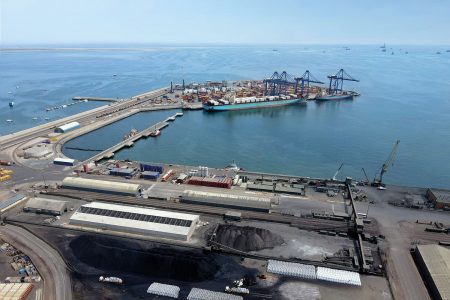
Construction of the proposed Trans Kalahari Railway linking Botswana to Namibia’s Walvis Bay port should commence as soon as possible, according to Botswana President Duma Boko.

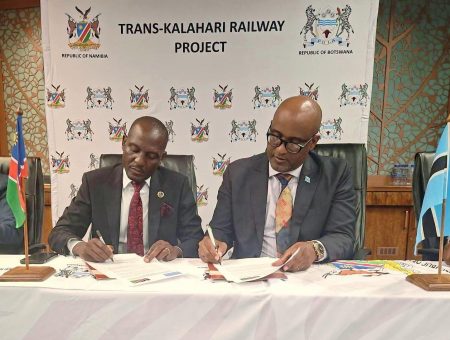
Boko said recent discussions with his Namibian counterpart, President Netumbo Nandi-Ndaitwah, resulted in an agreement to accelerate the implementation of the project.

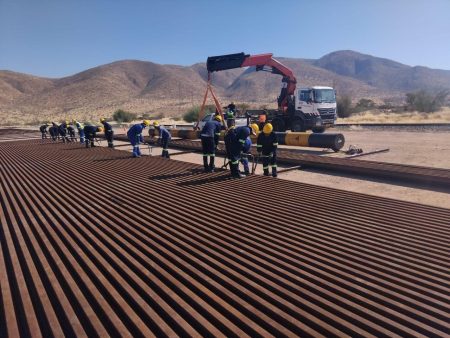
Namibia and Botswana have agreed to commence construction of the railway line before the end of this year, Boko said.

He made the disclosure during a meeting with Dangote Group chief executive officer Aliko Dangote, where he highlighted opportunities for the Nigerian industrial group to participate in the development of the railway project.

According to Boko, Dangote Group could supply cement and other products required for the construction of the railway.

He said the project would create significant business opportunities for Dangote Group because of the expected demand for cement and other construction-related products, as well as opportunities arising from the broader development associated with the railway.

Boko said Botswana was planning to undertake several major infrastructure projects, including the Trans Kalahari Railway, as part of efforts to strengthen the country’s transport and trade infrastructure.

Dangote said the group’s main focus was to contribute to the development of Africa by working with governments and the private sector.

He said the group was also looking at ways of using pension funds in Africa to support infrastructure and development projects across the continent.

The feasibility study for the Trans Kalahari Railway Line has been completed. According to Botswana’s Ministry of Transport, the next steps include interrogating the recommendations of the feasibility study, agreeing on financing mechanisms and establishing transparent procurement strategies.

The ministry has also identified continuous community engagement as an important part of the project’s implementation.

The project is expected to move into a Request for Proposals (RFP) and procurement phase for the appointment of a developer under a Public-Private Partnership (PPP) model.

The proposed railway is intended to improve regional connectivity and provide Botswana with access to the Port of Walvis Bay, strengthening transport links between the landlocked country and Namibia’s Atlantic coast.

Botswana also believes that the proposed railway line from Mosetse through Kazungula to Livingstone could provide a link to the Lobito Corridor, expanding the country’s access to regional trade routes.

Botswana has expressed interest in taking a stake in Angola’s Lobito refinery, which forms part of the wider development of the Lobito Corridor and associated infrastructure. Botswana has indicated its interest in participating in developments around the Lobito refinery.

The country is also pursuing other transport infrastructure opportunities with neighbouring countries.

These include cooperation involving Zimbabwe and Mozambique to expand the Port of Beira to Harare corridor, with the objective of improving transit times and increasing transport capacity for landlocked economies.

The development of the Beira-Harare corridor forms part of wider regional efforts to improve connectivity between landlocked countries and ports serving international markets.

Related News Articles