The Namibian Ports Authority handled 1.96 million tonnes of cross-border cargo in the 2025/26 financial year, of which Zambia accounted for 524,303 tonnes. The Walvis Bay–Ndola–Lubumbashi corridor is one of five strategic routes identified by the Zambian government as part of its five-year development agenda.
The pipelines Zambia intends to build comprise the Angola–Zambia, Namibia–Zambia refined-petroleum and natural-gas, Tanzania–Zambia multiproduct and Zimbabwe–Zambia pipelines. They form part of Zambia’s strategy to diversify its fuel supply routes.
- Zambia has announced that it will accelerate development of the Walvis Bay–Ndola–Lubumbashi transport corridor and pursue refined-petroleum and natural-gas pipelines linking Namibia and Zambia.
- The Namibian Ports Authority handled 1.96 million tonnes of cross-border cargo in the 2025/26 financial year, of which Zambia accounted for 524,303 tonnes.
- The Walvis Bay–Ndola–Lubumbashi corridor is one of five strategic routes identified by the Zambian government as part of its five-year development agenda.
- The pipelines Zambia intends to build are the Angola–Zambia pipeline, the Namibia–Zambia refined-petroleum and natural-gas pipelines, the Tanzania–Zambia multiproduct pipeline and the Zimbabwe–Zambia pipeline.
- President Hakainde Hichilema announced the plans as infrastructure priorities under the Grow Zambia Agenda, which also covers road and rail connectivity, airports, digital networks and border facilities.
- Zambia is targeting annual copper production of three million tonnes, electricity-generation capacity of 10,000 megawatts and five million international tourist arrivals a year.
Zambia will accelerate development of the Walvis Bay–Ndola–Lubumbashi transport corridor and pursue the construction of refined-petroleum and natural-gas pipelines linking Namibia and Zambia as part of efforts to establish itself as a regional transport and logistics hub.
The plans place Namibia’s transport and energy infrastructure among the routes Zambia intends to develop to improve regional connectivity, trade and security of fuel supplies.
Of the 1.96 million tonnes of cross-border cargo handled by the Namibian Ports Authority in the 2025/26 financial year, Zambia accounted for 524,303 tonnes.
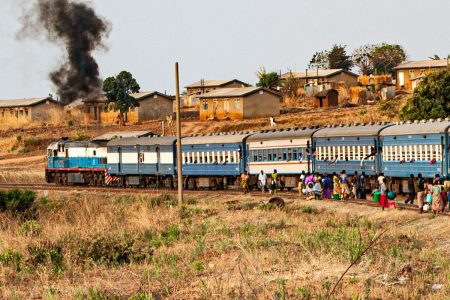
Zambia’s usage of the port of Walvis Bay could further increase if the proposed Trans-Zambezi Railway extension linking Namibia and Zambia is constructed.
By positioning and stabilising itself as a regional transport and logistics hub, Zambia hopes to accelerate the development of strategic transport corridors, including the Durban, Walvis Bay–Ndola–Lubumbashi, Lobito, TAZARA and Nacala corridors.
The Walvis Bay–Ndola–Lubumbashi corridor is one of five strategic routes identified by the Zambian government as part of its five-year development agenda.
The government would also pursue the construction of pipelines connecting Zambia with neighbouring countries, including Namibia, Angola, Tanzania and Zimbabwe.
The country will also work on the construction of the Angola–Zambia pipeline, the Namibia–Zambia refined-petroleum and natural-gas pipelines, the Tanzania–Zambia multiproduct pipeline and the Zimbabwe–Zambia pipeline.
The proposed pipelines form part of Zambia’s strategy to diversify its fuel supply routes and reduce its vulnerability to disruptions affecting a single supply corridor.
Zambian President Hakainde Hichilema announced the plans outlining infrastructure priorities under his administration’s Grow Zambia Agenda.
Under the Grow Zambia Agenda, the government plans to improve road and rail connectivity, upgrade airports, strengthen digital networks and modernise border facilities.
The government intends to digitise border processes, remove unnecessary administrative barriers and move towards seamless, non-stop border operations.
Zambia also plans to use economic diplomacy to expand market access for its goods and services through regional and international trade arrangements, including the Southern African Development Community (SADC), the Common Market for Eastern and Southern Africa (COMESA) and the African Continental Free Trade Area.
The transport and logistics strategy forms part of a broader economic programme aimed at expanding production, creating jobs and more than doubling the size of Zambia’s economy from when Hichilema’s administration assumed office in 2021.
Zambia has identified mining, agriculture, tourism, energy and manufacturing as key sectors in the government’s growth strategy.
Zambia is targeting annual copper production of three million tonnes, electricity-generation capacity of 10,000 megawatts and five million international tourist arrivals a year.
Written by Chamwe Kaira for Railways Africa