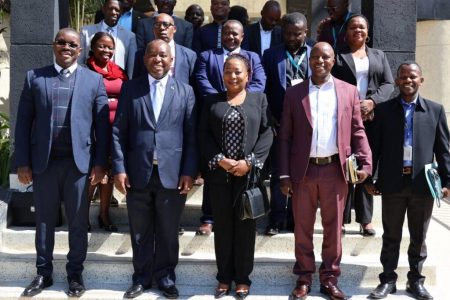
The approximately US$6.3 million (999 million Japanese yen) Japanese grant, signed on 22 October 2026, will fund crane-equipped motor cars and road-rail crane trucks for Zambia Railways. Japanese ambassador to Zambia Akiteru Mikami said the grant was aimed at strengthening the maintenance capacity of Zambia Railways Limited.
Zambia has set a target of increasing annual copper production to 3 million tonnes by 2030, and Zambia Railways’ strategic business plan for 2024 to 2028 sets out an increase in annual freight cargo hauled from 800,000 tonnes to 2,600,000 tonnes by 31 December 2028.
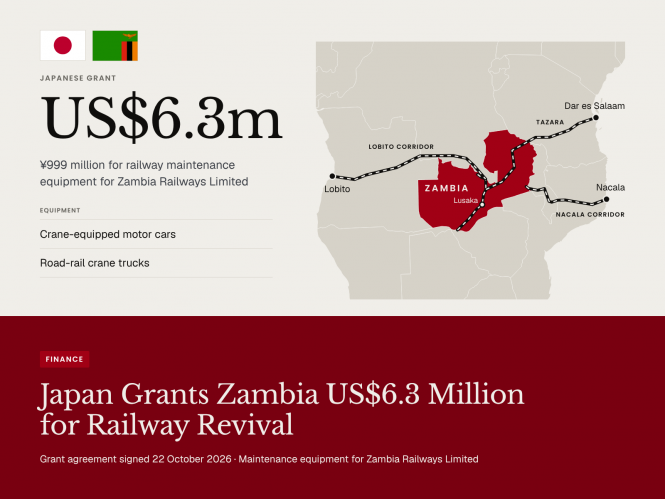
- Zambia Railways will receive approximately US$6.3 million (999 million Japanese yen) in Japanese grant funding to acquire railway maintenance equipment.
- The grant agreement was signed on 22 October 2026 by Finance Minister Situmbeko Musokotwane and Japanese ambassador to Zambia Akiteru Mikami.
- The equipment, manufactured by Japanese companies, includes crane-equipped motor cars and road-rail crane trucks.
- Japanese ambassador to Zambia Akiteru Mikami said the grant was aimed at strengthening the maintenance capacity of Zambia Railways Limited.
- Zambia has set a target of increasing annual copper production to 3 million tonnes by 2030.
- Zambia Railways’ strategic business plan for 2024 to 2028 sets out an increase in annual freight cargo hauled from 800,000 tonnes to 2,600,000 tonnes by 31 December 2028.
Zambia Railways will receive approximately US$6.3 million (999 million Japanese yen) in Japanese grant funding to acquire railway maintenance equipment as the country seeks to improve its transport infrastructure and strengthen its export capacity.
The equipment, manufactured by Japanese companies, includes crane-equipped motor cars and road-rail crane trucks intended to improve track maintenance and support reliable railway operations.
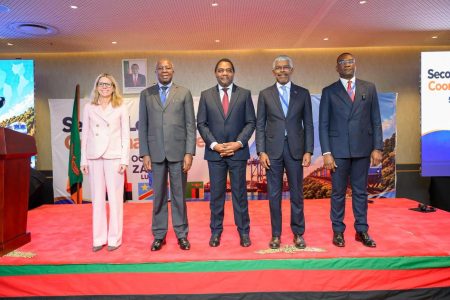
The grant agreement was signed on 22 October 2026 by Finance Minister Situmbeko Musokotwane and Japanese ambassador to Zambia Akiteru Mikami, according to the Ministry of Finance and National Planning.
Japanese ambassador to Zambia Akiteru Mikami said the grant was aimed at strengthening the maintenance capacity of Zambia Railways Limited, reflecting Japan’s view that railway infrastructure is essential for social and economic development.
The support comes as Zambia seeks to expand its copper production and improve transport links to regional markets. The country has set a strategic target of increasing annual copper production to 3 million tonnes by 2030.
An efficient railway network is expected to help reduce transportation costs, improve logistics and support domestic industries and wider economic activity.
Japan, which has an established railway network and technological expertise, intends to share its experience to support the development of Zambia’s railway infrastructure and strengthen the country’s transport capacity.
Zambia occupies a strategic position at the intersection of major transport corridors in southern Africa, making improvements to its railway network important for regional trade and the movement of mineral resources.
The country is also part of the Nacala Corridor, which links Zambia and Malawi to Mozambique. Japan is supporting efforts to improve transport infrastructure and connectivity along the corridor to facilitate industrial development and increase the movement of minerals and other goods.
Japan has committed funding worth at least 47.6 billion yen for infrastructure development projects linked to the Nacala Corridor in Mozambique, Malawi and Zambia, to the Tokyo International Conference on African Development (TICAD).
Japan is also conducting research into a master plan for a critical minerals supply chain focused on the Copperbelt region.
Zambia’s finance minister, Situmbeko Musokotwane, has identified reliable transport infrastructure as a key requirement for export-led economic growth, noting that railways can reduce logistics costs and enable goods to reach international markets at competitive prices.
The Japanese grant forms part of Zambia’s broader efforts to develop an export-oriented economy by improving its railway systems and regional connections.
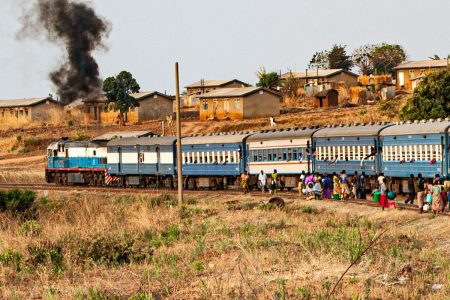
The government is pursuing several railway development initiatives, including the Lobito Corridor, the rehabilitation of the Tanzania-Zambia Railway Authority (TAZARA) railway, the development of the Nacala Railway link through Malawi and improvements to Zambia Railways, which connects the country to neighbouring markets in southern Africa.
These initiatives are intended to strengthen Zambia’s ability to transport minerals and other exports efficiently while improving regional trade links.
Zambia Railway’s strategic business plan 2024-2028, the company has plans to increase annual freight cargo hauled from 800,000 tonnes to 2,600,000 tonnes by 31 December 2028.
The government’s long-term targets include producing 10 million tonnes of maize, three million tonnes of soya beans, three million tonnes of copper, one million tonnes of sugar and one million tonnes of wheat by 2030.
Written by Chamwe Kaira for Railways Africa.