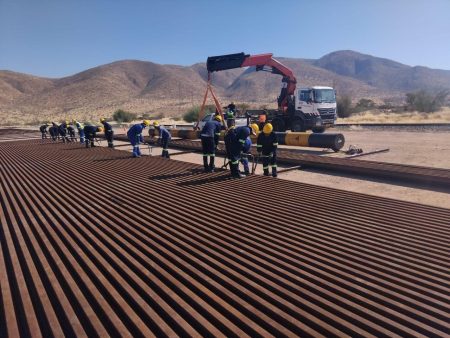
Namibia’s industrialisation ambitions depend on its ability to connect mineral resources, manufacturing centres and export markets through reliable transport infrastructure. The Trans-Kalahari and Trans-Zambezi railway projects could strengthen regional freight connectivity and access to the Port of Walvis Bay, but their contribution to industrial development will depend on progress beyond feasibility and procurement towards financing, construction and operational capacity.
The hydrogen dual-fuel locomotive pilot introduces a separate consideration for railway operators: whether lower-emission traction can deliver acceptable performance, reliability and operating costs under actual freight conditions. Its results could provide practical evidence for future traction investment decisions as Namibia seeks to develop industries that add value to its natural resources.
- The African Green Industries Summit, held in Swakopmund from 9 to 10 September, placed rail corridors, ports and clean transport technologies at the centre of Africa’s green industrialisation agenda.
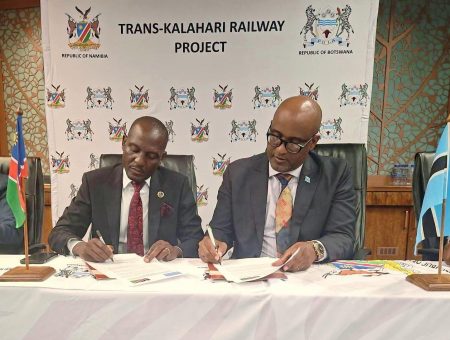
- The proposed 1,850km Trans-Kalahari Railway, linking Namibia and Botswana with regional markets, has entered its procurement phase.
- A feasibility study found the Trans-Kalahari Railway technically feasible, economically justified and capable of generating positive operating returns.
- Namibia has contracted consultancy services for a public-private partnership feasibility study on the Trans-Zambezi Railway, which would link Namibia and Zambia.
- TransNamib has approved a six-month dual-fuel locomotive pilot with CMB.TECH Namibia, covering approximately 50 return trips on the Walvis Bay to Windhoek corridor.
- Namibia’s National Development Plan 6 targets 1.3 million tonnes of green ammonia annually, 2 million tonnes of direct-reduced iron and 143 gigawatt-hours of green baseload electricity by 2030.
- Namibia is finalising a Sectoral Transformation Investment Plan intended to build a project pipeline able to access up to US$250 million in concessional finance.
Railways, ports and emerging clean transport technologies are increasingly being positioned as critical building blocks for Africa’s industrialisation, with the Africa Green Industries Summit 2026 placing transport infrastructure at the centre of discussions on how the continent can strengthen trade and compete in global markets.
Held in Swakopmund, Namibia from 9 to 10 September, the summit brought together stakeholders to examine how rail corridors, ports, green hydrogen and electrified mobility could support industrial development and the movement of goods across Africa.
A key discussion focused on the role of rail and ports as industrial catalysts, with particular attention given to the Trans-Kalahari and Caprivi rail corridors, regional value-chain development, implementation of the African Continental Free Trade Area (AfCFTA), trade facilitation and access to international markets.
The session also considered the development of green ports and included representatives from the Namibian Ports Authority, the International Trade Centre, the Port of Antwerp-Bruges in Belgium and NamPower.
The Trans-Kalahari Railway (TKR) emerged as one of the major infrastructure projects discussed at the summit. The proposed 1,850km railway linking Namibia, Botswana and regional markets has entered its procurement phase after a feasibility study found the project to be technically feasible, economically justified and capable of generating positive operating returns.
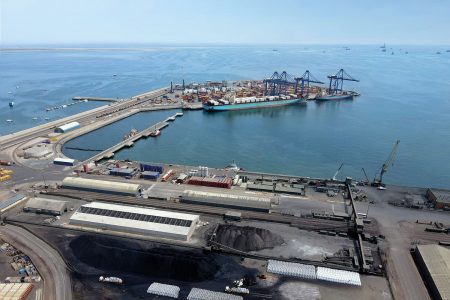
The Trans-Kalahari Railway is intended to improve access to major coal, copper and iron ore deposits in Botswana while strengthening the Port of Walvis Bay’s position as a regional import and export hub.
At the same time, Namibia is advancing plans for the Trans-Zambezi Railway, which would establish a rail link between Namibia and Zambia. Namibia has entered into a contract for consultancy services to conduct a public-private partnership feasibility study for the project.
The focus on rail infrastructure extended beyond conventional freight transport. A separate session, titled “Hydrogen on Track – Pioneering Low-Emission Rail in Namibia”, examined the potential for hydrogen to become part of the country’s future rail system.
The session centred on a dual-fuel locomotive pilot being led by TransNamib in partnership with CMB.TECH Namibia. Discussions covered the integration of hydrogen into rail operations, including locomotive performance, reliability, fuel efficiency, maintenance and cost-effectiveness.
TransNamib has approved a six-month pilot of a dual-fuel locomotive powered by hydrogen and diesel, marking a significant step towards lower-emission rail transport in Namibia.
In partnership with CMB.TECH Namibia, the trial will cover approximately 50 return trips along the Walvis Bay–Windhoek corridor, a vital artery for the country’s logistics and trade.
Namibia is targeting a significant expansion of manufacturing and secondary industries by 2030 as it seeks to shift from exporting raw materials towards greater domestic value addition and green industrialisation.
Namibia’s National Planning Commission Director-General and Chairperson of the Green Industries Council Kaire Mbuende said the country’s green industrialisation agenda was focused on using natural resources to build industries, develop skills and produce goods and services capable of competing in domestic, regional and international markets.
Mbuende said green hydrogen should be viewed as an enabler of broader green industrialisation rather than an end in itself. He said industrialisation required coordination across multiple sectors, including energy, water, ports, rail, mining, manufacturing, finance, trade, skills, environmental management and communities.
Namibia’s National Development Plan 6 identifies green hydrogen as a potential source of sustainable growth and employment.
Among its targets by 2030 are the production of 1.3 million tonnes of green ammonia annually, 2 million tonnes of direct-reduced iron and 143 gigawatt-hours of green baseload electricity. The plan also targets the creation of 30,000 green hydrogen-related jobs and 30% local content and participation by 2030.
To support the transition, Namibia is finalising its Sectoral Transformation Investment Plan under the Climate Investment Funds Industry Decarbonization Programme. The plan is intended to develop a pipeline of projects capable of accessing up to US$250 million in concessional finance for green industrialisation and the decarbonisation of hard-to-abate industries.