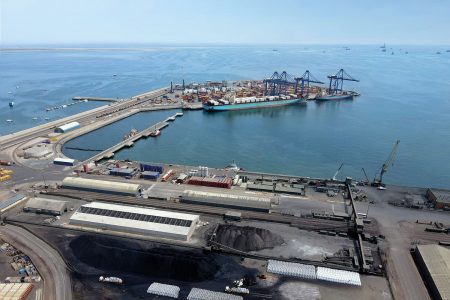
Expansion of the Botswana Container Terminal could strengthen the country’s access to international markets through the Port of Walvis Bay. Additional covered storage and logistics partnerships are intended to support greater container movement between the port and inland destinations.
The strategy also connects the dry port’s near-term development with the broader Trans Kalahari Corridor and the planned Trans Kalahari Railway. Together, these initiatives could provide Botswana with faster, more reliable and cost-effective access to the Atlantic Ocean.
The Botswana government-owned logistics company, Sea Rail, plans to increase its annual revenue by 25% as it expands operations at the Botswana Container Terminal in Walvis Bay and strengthens regional trade links through the Trans Kalahari Corridor.
Sea Rail managing director Derick Mokgatle said the company’s expansion strategy aims to establish a sustainable Botswana Container Terminal supported by strong partnerships that provide safe, reliable and cost-effective import and export services.
As part of the strategy, the Botswana government is in the process of promulgating dry port legislation to establish a clear regulatory framework for the sector.
Sea Rail also plans to expand its logistics value chain through partnerships with third-party service providers while strengthening collaboration with the Namibia Ports Authority (Namport).
In 2025, Namport handled 2,448,502 metric tonnes of cross-border cargo, with 18% of the cargo coming from Botswana, according to the 2025 Namport Integrated Annual Report.
The partnership will focus on developing additional under-roof storage capacity at the dry port, a move expected to increase the movement of containers between the port and inland destinations by road.
The expansion forms part of the broader Trans Kalahari Corridor development strategy, which seeks to improve regional trade connectivity through both road and the planned Trans Kalahari Railway.
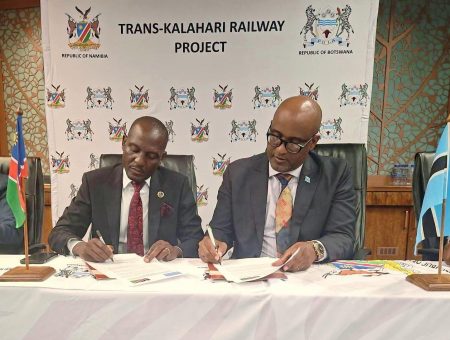
The Trans-Kalahari Railway (TKR) is a planned 1500 km heavy-haul railway linking the Mmamabula coal and mineral fields in Botswana to the Port of Walvis Bay in Namibia. Estimated to cost over US$16 billion, the project is completing feasibility studies with construction targeted to begin around 2027.
The Port of Walvis Bay, managed by Namport, serves as Botswana’s principal maritime gateway for international trade. The port’s North Port development area has been designated as the starting point for the planned Trans Kalahari Railway, which will connect Walvis Bay to Botswana.
According to Sea Rail, the Trans Kalahari Corridor has the potential to provide Botswana with faster, more cost-effective and reliable access to the Atlantic Ocean, improving the country’s import and export logistics.
Sea Rail and the Walvis Bay Dry Port
- Sea Rail is targeting annual revenue growth of 25%.
- The company operates the Botswana Container Terminal at Walvis Bay.
- Botswana is developing legislation to establish a regulatory framework for dry ports.
- Sea Rail plans to expand its logistics value chain through third-party service providers.
- Namport handled 2,448,502 metric tonnes of cross-border cargo in 2025.
- Botswana accounted for 18% of Namport’s cross-border cargo in 2025.
- Additional under-roof storage capacity is planned at the Botswana dry port.
- The dry port forms part of the broader Trans Kalahari Corridor development strategy.
Trans Kalahari Railway
- The proposed railway would link Botswana’s Mmamabula coal and mineral fields with the Port of Walvis Bay.
- The planned heavy-haul railway is approximately 1,500 km long.
- The project is estimated to cost more than US$16 billion.
- The Port of Walvis Bay’s North Port development area has been designated as the railway’s proposed starting point.