Why it Matters
The Trans-Cunene Corridor is becoming increasingly important as Namibia and Angola work to strengthen cross-border trade, improve logistics efficiency and support regional integration. For Southern Angola, the corridor provides a shorter and more competitive route through Walvis Bay, reducing transit time and logistics costs for key imports.
The corridor’s long-term significance also lies in its multimodal potential. Road upgrades, 24-hour border operations, possible One-Stop Border Post development and rail infrastructure planning all point to a broader regional logistics strategy that could strengthen trade flows between Namibia, Angola and the wider Southern African Development Community.
The Trans-Cunene Corridor is strengthening its role as a strategic trade route between Namibia and Angola, supported by rising cargo volumes through the Walvis Bay corridors, 24-hour border operations at Oshikango/Santa Clara, road infrastructure upgrades and long-term rail connectivity plans.
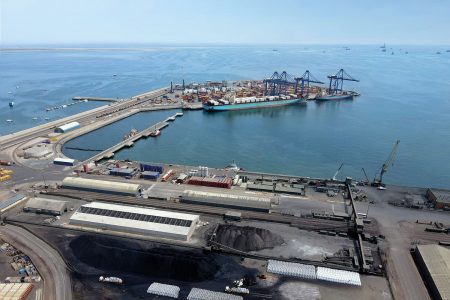
The Trans-Cunene Corridor (TCC), linking the Port of Walvis Bay to Southern Angola via Tsumeb, Ondangwa, Oshikango and the Santa Clara border post, continues to grow in importance as a key trade route between Namibia and Angola, according to the Walvis Bay Corridor Group (WBCG).
The corridor is increasingly central to regional trade within the Southern African Development Community (SADC), with the WBCG working alongside public and private sector stakeholders to improve efficiency, enhance competitiveness and increase cargo volumes along the route.
Collectively, cargo movement across the Walvis Bay corridors exceeded 2.4 million tonnes during the 2024/25 financial year. Over the same period, Namibia Ports Authority (Namport) recorded container throughput of 253,996 TEUs, a 33% year-on-year increase and the highest level in more than a decade. Total cargo throughput through the ports of Walvis Bay and Lüderitz reached 8.42 million tonnes, up from 8.03 million tonnes in the previous reporting period.
The TCC carries a wide range of goods between Namibia and Angola, including petroleum and fuel products, vehicles, mining inputs, construction materials, consumer goods and general retail items. The corridor is particularly important for supplying Southern Angola, offering shorter transit distances from Walvis Bay compared to alternative routes through Luanda, Lobito or Namibe. This advantage reduces transport time and logistics costs for traders.
Several recent developments are expected to further strengthen the corridor’s performance. A key milestone was the introduction of 24-hour operations at the Oshikango/Santa Clara border post in June 2024, implemented by the governments of Namibia and Angola. The round-the-clock service has improved cargo flow, reduced delays and boosted cross-border trade activity.
Ongoing road infrastructure improvements in both Namibia and Angola are also supporting increased trade volumes. On the Namibian side, a well-developed road network linking Walvis Bay to northern border posts continues to provide reliable freight movement. In Angola, upgrades to transport infrastructure are expected to further enhance connectivity and trade capacity.
Discussions are also underway on the possible establishment of a One-Stop Border Post between Namibia and Angola, a development that is expected to streamline customs procedures and improve regional trade efficiency.
On the Angolan side, increased investment in infrastructure and border facilitation is contributing to growing trade momentum in Southern Angola. These developments are expected to reinforce the Trans-Cunene Corridor’s position as a competitive and strategic trade route in the region.
In October 2023, the African Development Bank Group approved a loan of US$196.43 million to support Namibia’s efforts to modernise its railway infrastructure, some of which led to Angola under the second phase of the Transport Infrastructure Improvement Project (TIIP).
In December 2005, Angola’s Ministry of Transport launched a tender for a 30-year concession to operate and maintain the Namibe Corridor. The concession allows for the design and construction of new sections of railway, including links to Namibia and Zambia. The tender includes an option to extend the contract by 20 years if the lines to Namibia and Zambia are built.
Key Facts
Corridor:
Trans-Cunene Corridor
Route:
Port of Walvis Bay to Southern Angola via Tsumeb, Ondangwa, Oshikango and Santa Clara
Key border post:
Oshikango/Santa Clara
Main markets:
Namibia and Southern Angola
Cargo types:
Petroleum products, fuel, vehicles, mining inputs, construction materials, consumer goods and retail items
Walvis Bay corridors cargo movement:
More than 2.4 million tonnes in 2024/25
Namport container throughput:
253,996 TEUs in 2024/25
Namport cargo throughput:
8.42 million tonnes through Walvis Bay and Lüderitz
Border development:
24-hour operations introduced in June 2024
Rail-related development:
AfDB-backed railway infrastructure modernisation in Namibia and Namibe Corridor concession process in Angola
Written by Chamwe Kaira for Railways Africa