The completed procurement of 35,000 tonnes of rails and turnouts provides an update on the materials required for Namibia's railway upgrading programme, including the 207-kilometre Kranzberg–Otjiwarongo line. The project is designed to meet SADC railway standards and accommodate axle loads of up to 18.5 tonnes. Earthworks are progressing on Lots 1 and 3, procurement for the earthworks contracts under Lots 2 and 4 has been completed, and bridge designs have been finalised. These developments establish the different stages reached across the construction packages.
Progress on the Sandverhaar–Buchholzbrunn and Ondangwa–Oshakati lines, together with maintenance across approximately 1,000 kilometres of existing track, shows the range of work being undertaken across Namibia's network. The delivery of 21,500 concrete sleepers and progress on earthworks and bridge construction at Sandverhaar–Buchholzbrunn provide further evidence of implementation. Alongside these works, the proposed Trans-Kalahari and Trans-Zambezi railways and the ongoing legislative review form part of Namibia's wider railway development programme.
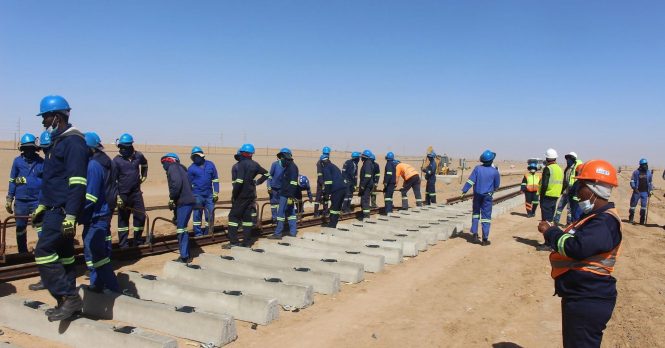
- Namibia has completed the procurement process for 35,000 tonnes of rails and turnouts, according to a budget accountability report issued by the Ministry of Finance.
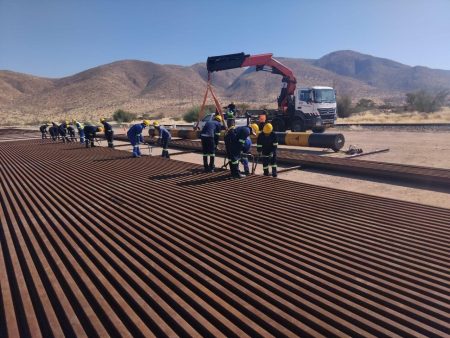
- The materials are 48-kilogram-per-metre rails and railway turnouts for the upgrading of several lines, including the 207-kilometre Kranzberg–Otjiwarongo section.
- The Kranzberg–Otjiwarongo upgrade is designed for axle loads of up to 18.5 tonnes to meet SADC railway standards.
- Earthworks are 23 per cent complete under Lot 1 and 17 per cent complete under Lot 3, and procurement of the Lot 2 and Lot 4 earthworks contracts has been completed.
- On the 40-kilometre Sandverhaar–Buchholzbrunn line, 12 kilometres of earthworks embankment are complete, four bridges are 20 per cent complete and 21,500 P2 concrete sleepers have been delivered.
- The review of Namibia’s primary railway legislation has reached 50 per cent completion.
Namibia has completed the procurement process for 35,000 tonnes of railway rails and turnouts for the upgrading of several railway lines, including the 207-kilometre Kranzberg–Otjiwarongo section.
A budget accountability report issued by the Ministry of Finance shows that the materials comprise 48-kilogram-per-metre rails and railway turnouts, which allow trains to move safely from one track to another.
The Kranzberg–Otjiwarongo railway line is being upgraded to meet Southern African Development Community (SADC) railway standards. The upgraded track is designed to accommodate axle loads of up to 18.5 tonnes per axle, enabling it to carry heavier trains.
Progress on the project varies across its construction sections. Under Lot 1, earthworks have been completed on 23 per cent of the 50-kilometre section allocated to Contractor 1, while 17 per cent of the 50-kilometre section allocated to Contractor 3 under Lot 3 has been completed.
The procurement process for the earthworks contracts under Lots 2 and 4 has also been completed, paving the way for construction activities to proceed.
The designs for bridges along the Kranzberg–Otjiwarongo section have been completed, marking progress towards upgrading the structures.
Meanwhile, work is underway to upgrade the 40-kilometre Sandverhaar–Buchholzbrunn railway line. The report states that 12 kilometres of earthworks embankment have been completed, while construction of four bridges along the route has reached 20 per cent completion.
A total of 21,500 P2 concrete sleepers has also been supplied and delivered for the Sandverhaar–Buchholzbrunn project. The sleepers support the rails, maintain track alignment and contribute to railway safety and durability.
The ministry also maintained approximately 1,000 kilometres of railway track across the national network. Maintenance was carried out along the Kranzberg–Otjiwarongo, Otjiwarongo–Tsumeb and Ariamsvlei–Lüderitz railway sections.
Construction of the permanent way on the Ondangwa–Oshakati railway line is also progressing. The permanent way comprises the rails, sleepers and supporting foundation that form the railway track.
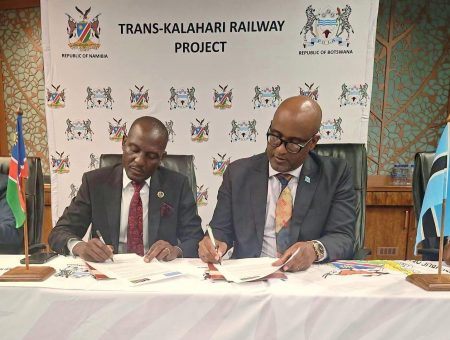
Beyond the ongoing upgrades, Namibia is advancing plans for new railway infrastructure through the proposed Trans-Kalahari and Trans-Zambezi railway developments. These are classified as greenfield projects, meaning they involve constructing new railway lines where no existing infrastructure is in place.
The report also indicates that the review of Namibia’s primary railway legislation has reached 50 per cent completion. The review includes an assessment of existing policies governing railway transport to ensure they remain relevant and aligned with the country’s railway development requirements.
The work is intended to strengthen the legal and policy framework governing the sector and support a safer, more efficient and sustainable railway system.
The projects form part of Namibia’s broader efforts to modernise and expand its railway network, improve connectivity between regions and strengthen the movement of goods and people, including links with neighbouring countries and regional markets.
Written by Chamwe Kiara for Railways Africa Magazine