What Africa’s Corridors Agenda Now Demands: Continuity, Coordination and Delivery

What Africa’s Corridors Agenda Now Demands: Continuity, Coordination and Delivery
Photo credit: Railways Africa // Craig Dean

A panel discussion at last year’s Lunda Finance Summit on capital, corridors and trade converged on a clear conclusion: Africa’s infrastructure challenge is no longer just about ambition or planning.

Transport infrastructure should not just be viewed as a collection of assets, but as an integrated economic system in which governance, reform, project readiness and private sector participation determine whether corridors deliver strategic economic outcomes, including increased trade and sustainable job creation, aligned with the Sustainable Development Goals and the Africa We Want.

Corridors as economic systems, not just singular transport projects

The evolving corridor model positions infrastructure as a backbone for broader economic activity rather than an end in itself. Rail lines, roads, ports, aviation and logistics hubs are now being viewed alongside power generation, mining, agriculture, ICT, tourism services and industrial value chains. The intent is to coordinate these elements so that transport investments directly support production, processing and trade.

Within this approach, corridors are expected to deliver more than reduced travel times. They are being positioned as platforms for value chain development, regional integration and industrialisation, with mining and agriculture identified as immediate anchors and services emerging as spillover sectors.

What Africa’s Corridors Agenda Now Demands: Continuity, Coordination and Delivery
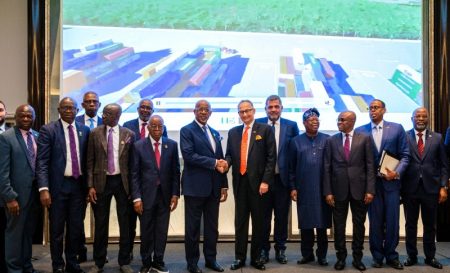
Egyptian Minister of Transport, Kamel Al-Wazir. Photo credit: Railways Africa // Craig Dean

Governance as delivery infrastructure

One of the clearest signals is the elevation of governance from a background consideration to a central delivery tool. Long preparation and construction timelines expose corridor projects to political change and shifting priorities. Without institutional anchors, early momentum can dissipate before projects reach implementation.

The response taking shape is institutionalisation. Dedicated corridor governance structures are intended to provide continuity across political cycles, coordinate multiple member states and move projects beyond informal cooperation. These structures are expected to support harmonisation of policies, standards and procedures, and to make operational decisions without repeated political renegotiation.

In practice, this marks a transition from corridors as political commitments to corridors as managed programmes.

Examples of this would be the Trans-Kalahari Railway Project Management Office and perhaps even the Lobito Corridor Investment Promotion Authority.

From infrastructure outputs to economic outcomes

Another defining shift is the move away from measuring success by kilometres built toward measuring outcomes in trade volumes, job creation and productivity. Infrastructure alone does not guarantee these results.

Border delays, inconsistent regulations and uncompetitive logistics markets can erase the benefits of new roads or rail lines. As a result, reforms are being treated as integral to corridor programmes rather than as secondary measures to be addressed later. Trade facilitation, competition policy, customs processes and regulatory harmonisation are increasingly seen as prerequisites for infrastructure to deliver its intended impact.

What Africa’s Corridors Agenda Now Demands: Continuity, Coordination and Delivery
Photo credit: Railways Africa // Craig Dean

Prioritisation in a constrained environment

Despite strong continental planning frameworks, resource constraints are forcing more deliberate prioritisation. Not every corridor can be built at once, and existing assets must also be maintained and rehabilitated. This has sharpened the focus on sequencing, selection and feasibility.

Corridors are increasingly being assessed against specific economic objectives, such as food security, mineral value addition or regional trade potential, rather than purely on connectivity logic. This introduces a more disciplined approach to investment, particularly in an environment of limited fiscal space and heightened scrutiny from financiers.

Breaking the project preparation cycle

A persistent bottleneck remains project readiness. Many initiatives progress through pre-feasibility and feasibility studies, but stall before financing is secured. When funding opportunities re-emerge years later, studies require updating and momentum is lost.

To address this, greater emphasis is being placed on continuity in project preparation and on involving financiers and the private sector earlier in the process. The objective is to embed bankability criteria from the outset, reducing the risk of projects cycling endlessly through studies without reaching implementation.

Dedicated corridor authorities are also being positioned as vehicles to manage preparation, implementation and coordination on behalf of member states, reducing fragmentation and duplication.

SMEs at the centre of corridor economies

Small and medium-sized enterprises are increasingly recognised as the operational backbone of corridor economies. While governments provide the enabling environment, SMEs are expected to populate value chains, provide services and drive cross-border trade.

For this to happen, attention is shifting toward capacity building, standards alignment and access to finance. SMEs need clarity on the requirements of larger corporates and access to platforms that link them into national, regional and global value chains. Corridor governance models are beginning to incorporate formal mechanisms for private sector participation to ensure that regulatory harmonisation reflects commercial realities.

Data, harmonisation and the border challenge

Effective corridor management depends on data. Institutional capacity to collect, analyse and use data is becoming a priority, both for tracking performance and for guiding investment decisions.

At the same time, borders remain the pressure point for corridor performance. Harmonisation of procedures, technical standards and systems, particularly in rail and customs operations, is essential. One-stop border posts and coordinated regulatory frameworks are increasingly viewed as critical infrastructure in their own right.

Financing corridors at scale

Corridor delivery is also driving innovation in financing approaches. Blended finance, leverage mechanisms and risk instruments are being used to expand the funding envelope for regional projects. By combining concessional resources, guarantees and private capital, corridor programmes aim to move beyond isolated project financing toward portfolio-based investment strategies that are more attractive to investors.

What this means now

Taken together, these themes point to a maturing phase in Africa’s corridor agenda. The focus is shifting from announcing projects to making them work. Governance, reform, preparation quality and private sector integration are becoming as important as concrete and steel.

For interested parties, the signal is clear. Opportunities lie not only in construction, but in logistics, services, value chains and project preparation. The corridors that progress will be those that are institutionally anchored, reform-ready and capable of sustaining delivery over time.

Footnote

Written by Phillippa Dean, Editor - Railways africa

Related News Articles