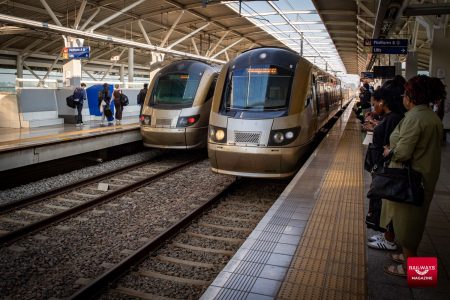
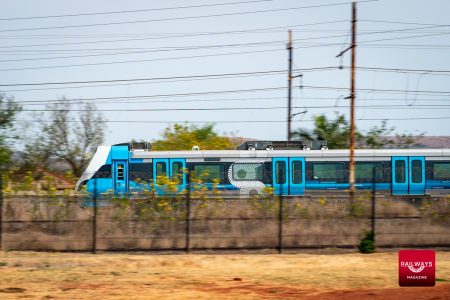
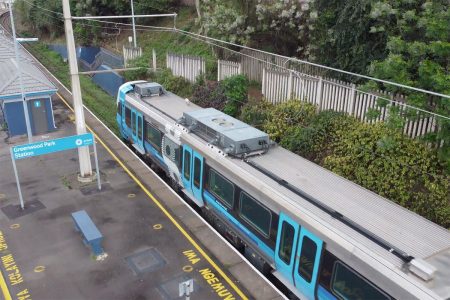
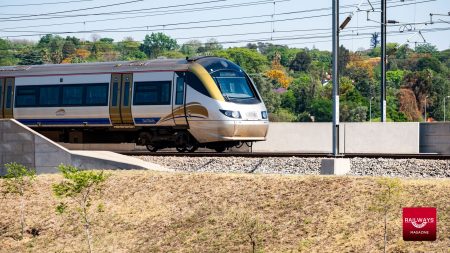
The South African rail sector is positioning itself for a major transformation, with industry leaders, policymakers and private operators aligning around a bold target to move 250 million tons of freight annually on South Africa’s rail network.
This emerged during a webinar titled “The Power of Local Evidence-Based Localisation for a Competitive Rail Sector,” moderated by Harry van Huyssteen and hosted by the African Rail Industry Association (ARIA).
ARIA chairperson Anand Moodliar said the 250-million-ton annual freight target, which was set by South Africa’s Transport Ministry, is central to the country’s economic recovery.
He described rail as a “binding constraint” on economic growth, noting that high logistics costs estimated at close to 15% of GDP are eroding competitiveness. According to Moodliar, improving the modal split between rail and road is the only sustainable way to reduce those costs.
The first five years of the rail reform journey will focus on bringing new capacity on stream.
Of the 250 million tons, state-owned freight operator Transnet is expected to contribute between 180 and 185 million tons. That leaves approximately 65 million tons to be delivered by private train operating companies (TOCs), which will introduce their own rolling stock into the system.
Moodliar indicated that procurement linked to this additional 65 million tons could amount to between R30 billion and R40 billion in new investment.
Tondani Nevhutalu, project manager at the Localisation Support Fund (LSF), said South Africa is currently importing more than R2.5 billion worth of rail equipment annually, eroding industrial depth and increasing foreign exchange exposure.
The LSF has already helped unlock around R200 million in localisation value-add across other sectors, including automotive, critical infrastructure, and clothing and textiles. It is now commissioning a six-month rail sector study with Letsema Consulting, endorsed by ARIA and aligned with the Department of Trade, Industry and Competition (DTIC).
The study will map the entire rail value chain, from design and manufacture to operations, maintenance and enablement, identifying participation hotspots, industrialisation gaps and future opportunities under the new Public Procurement Act framework.
Shenelle Nair of Letsema said the research would assess localisation from both individual and supplier perspectives, aiming to determine realistic thresholds and capacity levels.
ARIA CEO Mesela Nhlapo emphasised that localisation, transformation and job creation are foundational pillars of South Africa’s National Rail Policy.
Nhlapo argued that rail reform must move the industry away from being solely centred around Transnet, while still recognising its importance as an anchor player.
A key example of private sector commitment came from Traxtion, led by James Holly, which has procured rolling stock worth R3.4 billion. According to Nhlapo, the investment will create over 600 jobs near Rosslyn, predominantly for young people.
Moodliar also announced that ARIA members have taken steps to localise locomotive production through the Class 23 Traxx locomotives produced by Alstom. Transnet currently has an order for 240 units, with production nearing completion.
The production line, which boasts 65% local content capability, is now positioned to supply locomotives to private TOCs. ARIA members have already ordered 28 electrically compatible units for allocated slots.
The rail sector has also received a block exemption from the Competition Commission, allowing companies operating on shared networks to collaborate on upstream and downstream optimisation initiatives. This includes joint procurement and coordinated planning, aimed at improving efficiency across corridors.
Moodliar highlighted opportunities along the North Corridor, currently dominated by the Richards Bay Coal Terminal export system, which operates at 26-ton axle load capacity primarily for coal. He suggested expanding heavy-haul capacity to include manganese and chrome, potentially increasing axle loads to 30 tons, which could dramatically improve competitiveness using existing infrastructure.
Moodliar said every one million tons of new volume on the rail network, at an average access fee of R100 per ton, implies R100 million per year in new access fees.
Transnet Chief Business Development Officer Yolisa Kani clarified that the 250-million-ton target applies to 12 TOCs, including Transnet Freight Rail (TFR), which remains the largest operator.
The Department of Transport, through the network statement process, will open the next round of slot applications in March or April, allowing new operators to apply annually.
Moodliar confirmed that the onboarding of 11 new TOCs, alongside Transnet’s base capacity of 185 million tons, leaves the 65-million-ton gap to be filled by existing and future private operators.
Lungiswa Gxowa from the Directorate of Rail Equipment stressed the importance of protecting domestic manufacturing and industrial jobs, noting that Transnet currently employs about half of its previous workforce.
She revealed plans to engage Transnet in making second-hand diesel locomotives available locally, allowing train operators to purchase domestic assets rather than importing equipment.
Written by Chamwe Kaira for Railways Africa