Tanzania Railways Sets Out Major SGR, MGR and TAZARA Expansion Programme

Tanzania Railways Sets Out Major SGR, MGR and TAZARA Expansion Programme
Photo Credit: © Railways Africa // Craig Dean

Tanzania’s railway sector is entering a critical phase of expansion, rehabilitation and commercialisation, with the Government placing continued emphasis on the Standard Gauge Railway (SGR), the Meter Gauge Railway (MGR) and the Tanzania-Zambia Railway Authority (TAZARA) as core assets in the country’s transport and logistics strategy.

The Ministry of Transport’s 2026/27 plan positions railway development as one of its central priorities. The programme includes continued construction and operation of the SGR, rehabilitation and improvement of the MGR and TAZARA railways, development of urban rail in Dar es Salaam, and the construction of a modern railway training centre. The Ministry has been allocated TSh 2.872 trillion for the 2026/27 financial year, of which TSh 2.746 trillion, or 95.62 percent, is for development projects. Rail infrastructure forms a substantial part of this development focus.

TRC Moves Towards Commercial Self-Reliance

Tanzania Railways Corporation (TRC) is being positioned as a more commercially self-reliant railway operator. Since its establishment, TRC had received Government salary subsidies, but from January 2026, it successfully began covering salaries and other charges without support from the Consolidated Fund. For approximately ten years, the Government had been providing TSh 12.92 billion annually to TRC for salaries.

This shift is presented as the result of stronger internal strategies, substantial investment, firm management of development projects and the use of ICT systems. For the 2026/27 financial year, TRC has set a target of collecting TSh 352.87 billion from internal sources derived from passenger and cargo transport services on the MGR and SGR networks.

SGR Programme Continues Across Multiple Corridors

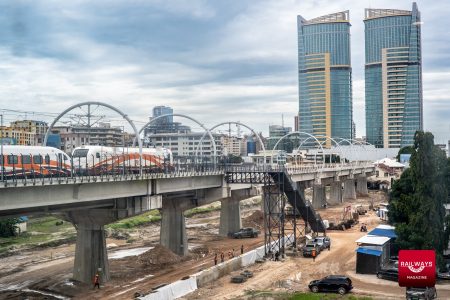
The Government, through TRC, continues to build and operate the SGR while improving the existing MGR network, which is approximately 2,707 kilometres long. The SGR programme is being implemented in two phases.

The first phase covers 1,219 kilometres of the main line from Dar es Salaam to Mwanza. The second phase covers 1,590 kilometres, including the Tabora-Kigoma and Uvinza-Musongati sections. Once both phases are completed, Tanzania will have a total modern SGR network of 2,809 kilometres.

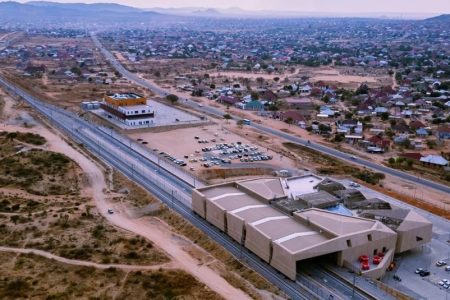
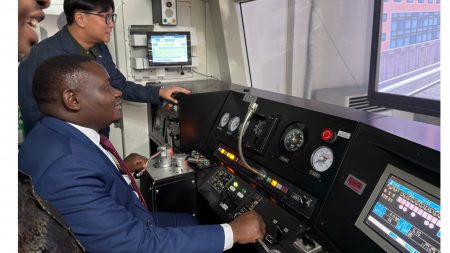
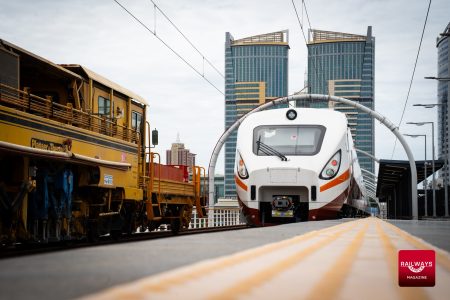
By March 2026, the first SGR section from Dar es Salaam to Morogoro, covering 300 kilometres, and the second section from Morogoro to Makutupora, covering 422 kilometres, had largely been completed. Remaining works include the construction of the port link, overpasses on the second section, stations on the second section and fencing. TRC is already operating train services on the completed sections.

Construction is continuing on the third and fourth sections. The Makutupora-Tabora section covers 368 kilometres, with ongoing works including detailed design, embankment construction, bridges, culverts and land acquisition. The Tabora-Isaka section covers 165 kilometres, with works including detailed design, soil and rock investigations, embankments, culverts, land acquisition and delivery of materials.

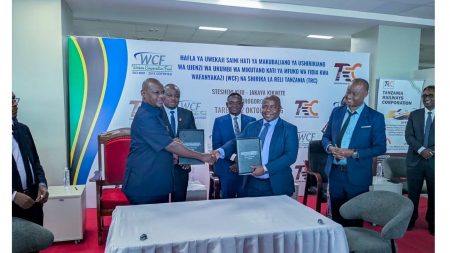
These two sections had experienced long-standing implementation challenges, slowing progress. The Government has since secured a concessional loan worth US$1.277 billion, equivalent to approximately TSh 3.32 trillion, for continued construction. The agreement was signed on 28 April 2026 in Dodoma and covers the Makutupora-Tabora and Tabora-Isaka sections, together totalling 533 kilometres.

The Mwanza-Isaka section, covering 341 kilometres, had reached 68.77 percent completion by March 2026. Ongoing works include detailed design, embankments, station buildings, bridges, pedestrian and animal crossings, track laying, communications and electricity systems, and land acquisition.

SGR Expansion Targets Burundi, DRC and Regional Trade

Tanzania’s SGR development is also being positioned as a regional trade platform. The Government’s stated objective is to make Tanzania a trade hub in East and Central Africa by extending rail connections to neighbouring countries, particularly Burundi and the Democratic Republic of Congo.

Construction of the Tabora-Kigoma SGR section, covering 506 kilometres, is ongoing and had reached 9.59 percent by March 2026. Works include embankments, crossings, the construction of the Malagarasi Bridge and design.

The Uvinza-Musongati section, covering 300 kilometres, is also progressing through initial preparations, including design and the delivery of materials, equipment and experts. Once completed, these railways are expected to connect the Port of Dar es Salaam with Burundi and the DRC, supporting cargo movement and trade between Tanzania and those markets.

The Government is also seeking funding from development partners and the private sector for additional SGR projects. These include:

  • Kaliua-Mpanda-Karema, covering 321 kilometres.
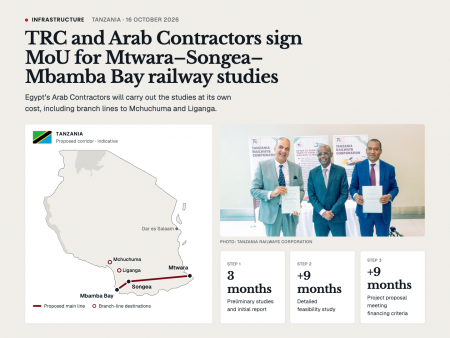
  • Mtwara-Mbamba Bay, including the Liganga and Mchuchuma branches, covering 1,000 kilometres.
  • Tanga-Arusha-Musoma, covering 1,028 kilometres.
  • Urban rail in Dar es Salaam, covering 166 kilometres.
  • Urban rail in Dodoma, covering 107 kilometres.

These projects are intended to support a broader national SGR network linking major cities, ports and neighbouring countries.

SGR Passenger Volumes Continue to Grow

Passenger transport on the SGR between Dar es Salaam and Dodoma has continued to improve. Between July 2025 and March 2026, TRC transported 2,515,203 passengers, compared with 2,054,828 passengers during the same period in the 2024/25 financial year. This represents an increase of 22.40 percent.

Since SGR operations began in June 2024, passenger numbers had reached 5,512,995 by March 2026. The growth is attributed to the quality and reliability of the service. The July 2025 to March 2026 passenger figure represents an average of 280,000 passengers per month, or approximately 9,300 passengers per day, equivalent to 170 large buses per day.

Based on current performance, it is estimated that more than 3 million passengers will be carried by the end of the 2025/26 financial year. This compares with an average of 400,000 passengers previously transported annually by the MGR.

In terms of revenue, TRC collected TSh 82.77 billion from passenger transport between Dar es Salaam and Dodoma during the period from July 2025 to March 2026. Since SGR services began in June 2024, total collections reached TSh 169.37 billion.

To improve efficiency and passenger convenience, TRC added two services between Dar es Salaam and Morogoro from 18 April 2026, increasing daily services between those regions from four to six.

SGR Freight Services Begin Between Dar es Salaam and Dodoma

TRC has also begun cargo transport on the SGR. In July 2025, the Government, through TRC, officially started SGR freight services between Dar es Salaam and Dodoma/Ihumwa. By March 2026, the railway had transported 102,452 tonnes of cargo.

The Government is also implementing strategies to increase domestic cargo availability by promoting transport and logistics economic corridors along areas served by transport infrastructure. Companies are already coming forward to use the SGR for cargo transport, including Dangote, which is transporting cement.

To reduce congestion at the Port of Dar es Salaam, the Government is encouraging greater use of dry ports, including Ihumwa in Dodoma and Isaka in Shinyanga. In March 2026, TRC began transporting cargo to the Isaka Dry Port.

Tanzania Railways Sets Out Major SGR, MGR and TAZARA Expansion Programme
Photo Credit: © Railways Africa // Craig Dean

Connecting SGR and MGR for Freight Continuity

A key part of the rail freight strategy is the connection between the SGR and MGR networks. The Government is continuing construction works to connect the two systems in the Ruvu area, enabling cargo transportation from the ports of Dar es Salaam and Tanga. Implementation at Ruvu had reached 85 percent by March 2026.

TRC is also continuing work to connect the MGR and SGR networks in the Bahi area. The objective is to enable transhipment of cargo between the two railways for onward movement to areas including Isaka, Mwanza and Kigoma, as well as neighbouring countries. This is being treated as a short-term strategy for SGR cargo movement while construction of other SGR sections continues.

The Port of Dar es Salaam rail connection is also advancing. Construction of the section connecting the SGR to the Port of Dar es Salaam had reached 99.09 percent.

MGR Rehabilitation Targets Heavier Rail and Stronger Bridges

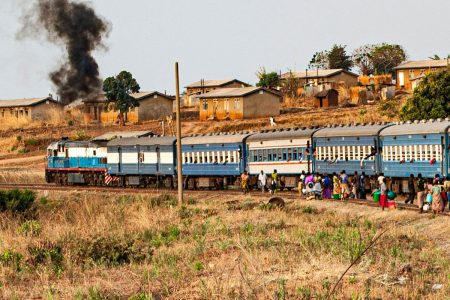
While the SGR is being expanded, the Government is also continuing to rehabilitate and improve the MGR network. The MGR remains important for both passenger and freight transport, particularly in areas still served by the existing network.

Rehabilitation includes removing 45-pound rails and replacing them with heavier 80-pound rails, while increasing bridge capacity from 13.5 tonnes to 18.5 tonnes per axle. The Railway Fund continues to support rehabilitation across different sections of the network.

By March 2026, rehabilitation of the Kaliua-Mpanda MGR line, covering 210 kilometres, had reached 32.72 percent. Works include track and bridge design, rehabilitation of Mpanda, Uyumbu, Kaliua and Katumba stations, construction of a sleeper factory, production of culverts, design of track and drainage systems, installation of stone-crushing equipment at Tumbi Quarry and delivery of materials.

Flood resilience is also a major part of the MGR programme. The MGR line in the Kilosa, Kidete and Igandu areas has been affected by frequent flooding. To address this, the Ministry has implemented emergency, short-term and long-term works, including the construction of a 6.2-kilometre railway line and bridge in the Godegode-Gulwe area, where construction had reached 99 percent.

The Ministry, working with the Ministry of Agriculture, the Ministry of Water and other stakeholders through the Tanzania Intermodal and Rail Development Project Phase II (TIRP II), is preparing for the construction and rehabilitation of six dams in the Kinyasungwe River catchment in Morogoro and Dodoma. These are Kidete, Kimagai, Buigiri, Ikowa, Hombolo and Dabalo. Two additional dams, Lumuma in Kilosa District and Mzase in Mpwapwa District, are also planned, bringing the total to eight. These dams are intended to reduce flooding impacts on railway infrastructure and support other economic activities such as agriculture, irrigation and livestock farming.

MGR Rolling Stock and Equipment Programme

The Government is also implementing measures to improve the availability of MGR equipment. These include rehabilitation of five mainline locomotives at the Morogoro workshop, which had reached 17 percent by March 2026 and is expected to be completed in December 2026.

Wagon rehabilitation is continuing at the Dar es Salaam workshop. By March 2026, 37 passenger coaches and 369 freight wagons had been completed and were operational. TRC is also procuring 100 new freight wagons.

In addition, eight locomotives are being manufactured, of which two have already arrived in Tanzania. Manufacture of the remaining six had reached 88 percent by March 2026.

These measures have increased TRC’s capacity to serve both passenger and cargo markets, including the movement of containers from the Port of Dar es Salaam to Kwala Dry Port and other destinations.

By March 2026, MGR cargo volumes had reached 203,920 tonnes, compared with 183,048 tonnes during the same period of the 2024/25 financial year, an increase of 11.40 percent. Long-distance passenger transport on the MGR reached 300,858 passengers by March 2026.

Private Sector Participation and Open Access

The Government is also expanding private sector participation in railway maintenance and service provision. Through TRC, a contract has been entered into with a private company for the outsourced maintenance of MGR railway lines, including Tanga-Arusha, Ruvu-Mruazi Junction and Dar es Salaam-Morogoro.

Works under these arrangements include culvert construction, ballast tamping, clearing railway lines and installing drainage channels.

TRC has also entered into a contract with a private company for the revival of five mainline locomotives, while rehabilitation of four shunting locomotives is in the initial preparation stage.

The Government is further encouraging private operators to use railway lines to provide transport and logistics services using their own locomotives and wagons under open access. The objective is to increase efficiency on both the MGR and SGR networks. Several companies have begun coming forward, and initial preparations, including contract processes, are ongoing.

Systems, ICT and Safety Improvements

Beyond track and rolling stock, TRC is implementing improvements to signalling, communications and electricity systems on the MGR line. ICT systems are also being improved, including the installation of CCTV cameras for security and safety in station areas and the use of electronic ticketing systems.

For the 2026/27 financial year, TRC plans to continue improving signalling and communications systems for both the SGR and MGR to support safe train operations.

TRC also plans to procure machinery and equipment for loading and unloading cargo on the MGR and SGR networks, and to engage locomotive maintenance service providers to ensure railway service availability in the country remains above 85 percent.

TAZARA Faces Performance Challenges, but Major Revitalisation Is Underway

The Governments of Tanzania and Zambia continue to cooperate through TAZARA, which is owned equally by the two countries on a 50/50 basis. The railway runs for 2,153 kilometres from Dar es Salaam in Tanzania to New Kapiri Mposhi in Zambia. This includes 1,860 kilometres of main line and 293 kilometres of station and branch lines.

TAZARA continues to provide transport and logistics services between the shareholder countries and other SADC countries. However, performance has been affected by ageing infrastructure and shortages of equipment, including locomotives, wagons and spare parts.

As of March 2026, 157,377 tonnes of cargo had been transported through TAZARA. Of this, 52,991 tonnes were transported by TAZARA, and 104,386 tonnes by private companies contracted to transport cargo using the railway. The railway’s designed capacity is 5 million tonnes per year.

Passenger performance has declined. Long-distance passenger trains between Dar es Salaam and New Kapiri Mposhi transported 216,018 passengers up to March 2026, compared with 416,768 during the same period of the previous financial year. The Udzungwa Train, operating between Kidatu and Makambako, transported 80,564 passengers, compared with 162,936 during the same period of 2024/25.

US$1.4bn TAZARA Concession With CCECC

A major revitalisation programme is now underway. The TAZARA railway revitalisation project was launched on 20 November 2025 in Lusaka, Zambia. This followed the signing, on 29 September 2025, of a concession agreement between the Governments of Tanzania and Zambia and CCECC of China.

CCECC is expected to invest US$1.4 billion, equivalent to approximately TSh 3.6 trillion, in the improvement of TAZARA. Initial implementation has begun, including surveying and designing railway infrastructure ahead of track rehabilitation.

The project is expected to increase cargo transport capacity from the current average of less than 150,000 tonnes per year to 2.4 million tonnes by the third year of operations after completion of major infrastructure repairs, procurement of locomotives and acquisition of more efficient modern wagons.

The improvements are also expected to generate 20,000 direct jobs and 80,000 indirect jobs. The project is expected to strengthen cargo movement through the Port of Dar es Salaam to and from Zambia, the DRC and other SADC countries, while also supporting domestic cargo movement.

The Government has also received requests from Malawi for a railway connection with TAZARA in Mbeya or Songwe Region. In addition, the DRC has requested to use TAZARA through Zambia’s railway network. The DRC rail system connects with TAZARA, which is Cape Gauge, and the large cargo volumes from the DRC, including minerals, are seen as a significant opportunity.

2026/27 Railway Project Allocations

Railway projects form a major part of the 2026/27 transport budget.

For the SGR Railway Construction Project, the Government has allocated TSh 1.51 trillion in domestic funding and TSh 61.84 billion in foreign funding. Activities include routine maintenance on the Dar es Salaam-Makutupora section, completion of the Morogoro-Makutupora section, continued construction of the Makutupora-Tabora, Tabora-Isaka, Mwanza-Isaka, Tabora-Kigoma and Uvinza-Musongati sections, procurement of locomotives, wagons, equipment, machinery, spare parts and maintenance materials, environmental and social management, and supervision and monitoring of SGR construction.

The Railway Infrastructure Rehabilitation Project through the Railway Fund has been allocated TSh 294.80 billion in domestic funding and TSh 5.18 billion in foreign funding. The allocation covers rehabilitation and maintenance of the MGR line, procurement of locomotives, wagons and equipment, procurement of maintenance materials, improvements to ICT and electrical systems, fencing and signage in railway areas, a feasibility study for modern urban rail in Dar es Salaam and construction of a modern railway college.

The MGR Railway Rehabilitation Project under TIRP II has been allocated TSh 89.90 billion in foreign funding for rehabilitation of the Dar es Salaam-Tabora and Tabora-Isaka sections, consultancy services and feasibility studies for the Kilosa-Mikumi, Tanga-Arusha and Kilosa-Gulwe-Igandu sections.

The TAZARA Railway Rehabilitation Project is expected to use TSh 12.32 billion in domestic funding for infrastructure maintenance, procurement of spare parts for locomotive maintenance, procurement and installation of an online ticketing system, and passenger and parcel inspection equipment.

2026/27 Operational Targets

For the 2026/27 financial year, TRC plans to transport approximately:

  • 584,000 tonnes of cargo on the MGR.
  • 1,500,000 tonnes of cargo on the SGR.
  • 662,000 long-distance passengers on the MGR.
  • 4,750,000 passengers on the SGR.
  • 3,128,000 passengers on urban rail.

TRC also plans to continue rehabilitation of railway infrastructure, workshop buildings, stations and staff camps; procure and rehabilitate locomotives and passenger and freight wagons; procure loading and unloading equipment for MGR and SGR cargo operations; and conduct feasibility studies and preliminary design for construction of the SGR from Isaka to Lusahunga to Mulongo/Kikagati to Mpondwe in Uganda.

TRC will also continue procuring locomotives, wagons, track maintenance plant and machinery, including 10 hybrid locomotives.

The annual targets of 1.5 million tonnes of cargo by SGR and 584,000 tonnes by MGR are based on the current condition of the infrastructure. By design, the SGR has the capacity to transport 17 million tonnes per year between the Port of Dar es Salaam and ports on Lake Victoria, Mwanza South, and Lake Tanganyika at Kigoma and Karema. The MGR has a designed capacity of 5 million tonnes per year.

The Government’s strategy is to complete the SGR from Dar es Salaam to Mwanza by the end of 2028, and from Dar es Salaam to Kigoma by the end of 2029, while completing MGR improvements. TRC’s Business Plan indicates that by the 2034/35 financial year, the railway will be able to transport an average of 4 million tonnes per year on the MGR and 10 million tonnes per year on the SGR.

For TAZARA, the Government expects to collect TSh 48.33 billion in 2026/27. Planned activities include continued improvement of the railway through cooperation between Tanzania, Zambia and CCECC; preventive maintenance on nine engines, 450 freight wagons and 18 passenger coaches; carrying 350,000 long-distance passengers and 150,000 passengers on the Udzungwa Train; transporting 100,000 tonnes of cargo using existing infrastructure before the investment begins; completing a detailed infrastructure condition assessment; and continuing training and recruitment to build human resource capacity.

Rail at the Centre of Tanzania’s Corridor Strategy

The scale of Tanzania’s railway programme shows that rail is being positioned as a central instrument for national logistics, regional trade and economic development. The SGR is being used to transform passenger mobility and begin large-scale freight movement from Dar es Salaam inland. The MGR is being rehabilitated to improve resilience, axle load capacity and freight continuity. TAZARA is being prepared for a major concession-backed rehabilitation intended to restore capacity on a strategic regional corridor.

Together, these programmes point to a railway strategy built around three objectives: modernising domestic rail services, integrating old and new railway networks, and strengthening Tanzania’s role as a regional logistics hub. With SGR expansion towards Mwanza, Kigoma and Musongati, MGR rehabilitation across key sections, and TAZARA’s planned recovery, Tanzania is positioning rail as a high-capacity platform for cargo movement from the Port of Dar es Salaam to inland markets and neighbouring countries.

Tanzania Railways Sets Out Major SGR, MGR and TAZARA Expansion Programme
Photo Credit: © Railways Africa // Craig Dean

Why it Matters

Tanzania’s rail programme is not only an infrastructure build-out. It is a national logistics strategy built around corridor competitiveness, port connectivity and the integration of legacy and modern railway assets. The SGR is already carrying passengers and has started moving freight, while MGR rehabilitation and SGR-MGR connections at Ruvu and Bahi are intended to keep cargo moving across the wider network.

The TAZARA revitalisation programme adds a regional dimension by targeting improved movement between the Port of Dar es Salaam, Zambia, the DRC and the wider SADC market. If implemented as planned, the combined SGR, MGR and TAZARA programmes will strengthen Tanzania’s position as a rail-linked gateway for East, Central and Southern African trade.

Footnote

Written by Phillippa Dean

Related News Articles