World Bank Report Calls for Shift from Trade Links to Production Hubs

The report puts a number on something the rail sector has long argued without evidence: that corridor performance, not track capacity, is what determines whether a cross-border railway earns its investment. A 10% gain in corridor reliability worth around 3.4% in bilateral regional value-added trade is a figure that can be carried into a business case, and it points at customs, standards and logistics rather than at civil works.

The Ethiopia-Djibouti and Mombasa examples set out the two outcomes available to any corridor project on the continent. Both had substantial infrastructure investment behind them, and the difference the report identifies lies in whether the rest of the system, ports included, performs to the same standard. For infrastructure managers, concessionaires and the development finance institutions funding them, the practical implication is that transit time and reliability data, of the kind the corridor authorities already collect, is becoming as material to a corridor's case as its design capacity.

World Bank Report Calls for Shift from Trade Links to Production Hubs
  • Integrating Africa: From Threads to Hubs was released on 28 August 2026 and launched in Addis Ababa at an event co-hosted by the African Union Commission, UNECA and the World Bank Group.
  • The report identifies the lack of transcontinental railway interconnectivity as one of the physical constraints on trade between Africa's Regional Economic Communities.
  • A 10% improvement in corridor reliability is estimated to increase bilateral regional value-added trade by around 3.4%.
  • Around 60% of estimated trade costs are attributed to unilateral or behind-the-border constraints.
  • The Ethiopia-Djibouti corridor is cited as operating below capacity because of port congestion, power outages and fragmented logistics; Kenya's Port of Mombasa and rail upgrades are cited as benefiting landlocked neighbours.

Rail and rail freight also feature in the report's assessment of restrictions in African transport services, an issue that falls hardest on landlocked countries whose access to ports and regional markets runs across several jurisdictions.

A new World Bank report has called for Africa’s next phase of regional integration to focus on connecting production across borders, reducing trade and regulatory friction and developing the infrastructure and services needed to support functioning regional markets.

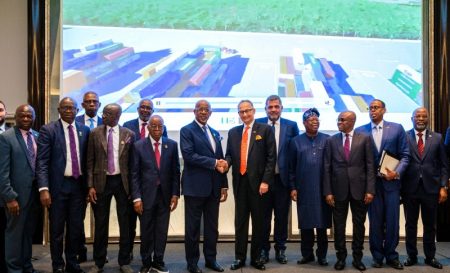
Released on 28 August, Integrating Africa: From Threads to Hubs sets out an agenda for turning continental commitments into operating markets and regional production hubs. The report was launched at an event co-hosted by the African Union Commission, the United Nations Economic Commission for Africa and the World Bank Group.

It calls for greater interoperability across customs, standards, payment, transport, energy and digital systems, allowing companies to source, produce, finance and sell across borders under more predictable rules and procedures.

According to the report, deeper liberalisation of transport, telecommunications, financial and professional services could increase trade in services within the AfCFTA area by around 60% to 64% by 2035, while also supporting increased intra-African trade and job creation.

Intra-regional trade currently accounts for roughly one-fifth of Sub-Saharan Africa’s total exports. The report argues that increasing this share would support value chains that are typically more diversified and manufacturing-intensive than exports to global markets, which remain concentrated on commodities.

Many of the barriers to regional integration remain within the control of individual countries. Around 60% of estimated trade costs are described as unilateral or behind the border, reflecting customs delays, inefficient logistics, transport restrictions, fragmented standards, barriers in services and weak infrastructure.

The report says this leaves considerable scope for governments to reduce the cost of regional trade through domestic reforms without waiting for further regional negotiations. Measures identified include electronic single windows, risk-based inspections, more competitive freight markets, simpler rules of origin, stronger standards institutions and more open transport, financial and professional services.

Its recommendations are structured around four priorities: building regional value chains that connect production across borders, reducing trade and regulatory friction, strengthening the implementation and enforcement of regional trade agreements, and delivering regional public goods including transport corridors, power markets, digital networks and payment systems.

World Bank Vice President for Eastern and Southern Africa Ndiamé Diop said the emphasis had shifted from establishing a continental free trade agreement to implementing it. He said the World Bank was working with the AfCFTA Secretariat, African institutions, governments and the private sector to connect 54 economies into an integrated continental market of 1.5 billion people, supported by regional production hubs capable of attracting investment and creating jobs.

African Union Commission Deputy Chairperson Selma Malika Haddadi said implementation would require cooperation between the African Union Commission, UNECA, the World Bank Group, member states, regional economic communities and the private sector to translate continental frameworks into practical investments and reforms.

The report proposes measuring progress through practical outcomes for businesses and communities, including shorter border-crossing times, lower logistics costs, more reliable regional infrastructure, the resolution of more non-tariff barriers, greater recognition of qualifications and standards across markets, increased private investment and wider participation by firms in regional value chains.

Download the report from here: https://openknowledge.worldban...

Related News Articles