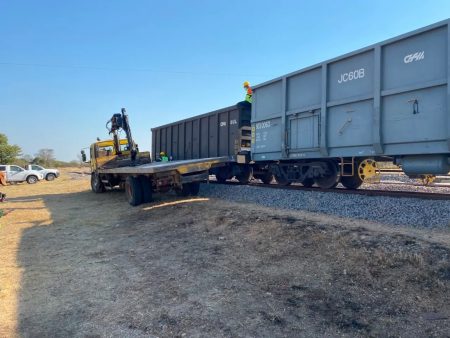
The South Africa-Zimbabwe Bi-National Commission has placed road and rail modernisation along the North-South Corridor among the priority areas for deeper bilateral cooperation. The emphasis is on improving connectivity through the Beitbridge gateway, better border management and stronger links between the two countries, rather than announcing a specific rail project or funding commitment.
For the rail sector, the significance lies in the political backing being given to corridor infrastructure as part of wider regional trade and industrialisation objectives. Any material change will depend on whether these bilateral priorities are converted into defined projects, budgets, implementation agreements or procurement.
- South Africa and Zimbabwe have identified road and rail modernisation along the North-South Corridor as a priority for bilateral cooperation.
- Beitbridge Border Post was highlighted as a major gateway on the corridor.
- Infrastructure connectivity is one of the key areas identified for accelerated cooperation.
- Other priority areas include energy, agriculture, critical minerals and private-sector investment.
- More than 33 agreements and memoranda of understanding have been concluded between the two countries through the BNC framework, which was establish in April 2015.
- No specific rail project, funding commitment, construction programme or procurement action was announced in the Ministerial statement.
- Zimbabwe was South Africa's second-largest agricultural export market in 2025, valued at approximately US$1.1 billion, while South Africa ranked second among Zimbabwe's agricultural export markets, at US$202 million.
South Africa and Zimbabwe have named infrastructure connectivity, including the modernisation of road and rail links along the North-South Corridor, among the priority areas for deeper bilateral cooperation, International Relations and Cooperation Minister Ronald Lamola said at the opening of the Ministerial segment of the Fourth Session of the South Africa-Zimbabwe Bi-National Commission (BNC) in Pretoria on 20 August.
Lamola said the two countries' “political relationship is strong” and their “historical bonds are deep,” but stressed the need to “convert these advantages into concrete programmes,” pointing to the Beitbridge Border Post as a major gateway on the North-South Corridor and calling for the modernisation of road and rail infrastructure, improved border management and strengthened regional connectivity. He identified infrastructure connectivity, energy, agriculture, critical minerals and private-sector investment as the key areas for accelerated cooperation.
On energy, Lamola called for collaboration on electricity generation, transmission and regional power connectivity through the Southern African Power Pool, including investment in new generation capacity and renewable energy.
Lamola said Zimbabwe was South Africa's second-largest agricultural export market in 2025, at approximately US$1.1 billion, while South Africa ranked second among Zimbabwe's agricultural export markets, at US$202 million. He said the two countries should expand cooperation on seeds, machinery and agro-processing to develop regional value chains, and pursue greater beneficiation of critical minerals.
Migration featured prominently on the agenda. Lamola described the Zimbabwe-South Africa route as one of Africa's busiest migration corridors, noting that Zimbabwean nationals account for approximately 48% of South Africa's migrant population, and said the two countries should strengthen cooperation on migration management and facilitate lawful movement. He welcomed a call by the Southern African Development Community (SADC) for a migration dialogue addressing the underlying drivers of migration.
Lamola said bilateral cooperation between the two countries should contribute to wider regional integration and to the implementation of the African Continental Free Trade Area, and called for joint initiatives supporting SADC priorities in infrastructure development, industrialisation, energy security, food security and regional value chains.