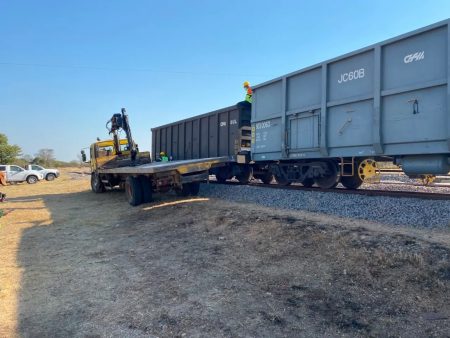
Railway connections between Mozambique’s capital, Maputo, and South Africa’s Limpopo Province have been severely disrupted by flooding, impacting rail links with South Africa, Eswatini and Zimbabwe. Mozambican authorities reported that the floods have left more than 100 people dead, with many others displaced.
Mozambique Railways Company (CFM) suspended train services on the Ressano Garcia and Goba railway lines, which connect Maputo with South Africa and Eswatini, following extensive flood damage. CFM said it is working to repair the Ressano Garcia line, which links the Port of Maputo with the Ressano Garcia border post into South Africa, after landslides destroyed sections of the track. The company also plans to drain water from several affected areas, including the Matola-Gare section within the Matola municipality.
Flooding also affected the Goba line, which connects Maputo with Eswatini, resulting in the suspension of services. These routes connect with the Limpopo Railway, which provides rail links between Mozambique and Zimbabwe. Operations on the Limpopo Railway were also suspended, with CFM indicating that services are expected to resume once repair works are completed.
Mozambique’s Ministry of Transport and Logistics estimated that approximately 3,000 kilometres of roads across the country have been significantly affected. The ministry said sections of the main north–south N1 road were flooded or washed away in Maputo and Gaza provinces, cutting all north–south road access in affected areas.
In Zimbabwe, the National Railways of Zimbabwe (NRZ) suspended rail traffic on the Chicualacuala–Maputo Corridor due to flood damage. NRZ advised customers and the public that the railway line between Chicualacuala and Maputo was temporarily closed following extensive washaways caused by heavy rainfall in Mozambique.
NRZ said the disruption affected the movement of rail traffic to and from Zimbabwe, routed through the corridor. It added that Mozambique Ports and Railways had indicated that repair works would commence once water levels subside and conditions permit.
Transnet noted that operations had been impacted and that assessments are currently underway.
The disruption follows shortly after the Port of Maputo announced record performance for 2025. In early January, Maputo Port Development Company (MPDC) reported that total cargo handled during the year reached an all-time high of 32 million tonnes, representing a 3.4% increase compared with the previous year.
Direct port operations also reached record levels, with 15.2 million tonnes handled, reflecting year-on-year growth of 6.4%. MPDC attributed the performance to sustained investment in infrastructure, operational systems and human capital, as well as ongoing improvements in productivity and efficiency.
Rail transport, a core element of the Port of Maputo’s sustainability and corridor development strategy, recorded particularly strong growth. Rail volumes increased by 17%, rising from 9.7 million tonnes in 2024 to 11.7 million tonnes in 2025, reinforcing the role of rail as a reliable and environmentally efficient mode of cargo movement.
In parallel, MPDC continued implementing its investment programme, including expansion of the bulk terminal to 16 million tonnes, the DP World container terminal to 530,000 TEUs, capacity upgrades at Grindrod’s magnetite and coal terminal to 12 million tonnes, and coordinated efficiency improvements along the wider logistics corridor. These initiatives remain aligned with MPDC’s long-term strategy to position the Port of Maputo as a modern, competitive and integrated regional logistics hub.
Written for Railways Africa by Chamwe Kaira.