World Bank’s Proposed SPRINT Programme Targets South Africa’s Freight Rail and Port Infrastructure

South Africa’s freight rail recovery depends on restoring infrastructure capacity alongside improvements in operational reliability. The proposed rehabilitation of key freight corridors would address deteriorating track, ageing electrification and obsolete signalling systems that constrain train movements and contribute to the diversion of freight to road transport. The programme also links infrastructure improvements to measurable operational outcomes, including the removal of speed restrictions and improvements in train-slot reliability.

For private train operators, freight customers and railway infrastructure suppliers, the proposed programme identifies the physical and operational improvements required to support greater use of the network. Its results-based financing approach would link disbursements to defined performance indicators, while the proposed works represent potential opportunities for railway engineering, track, electrification and signalling suppliers. The programme remains subject to appraisal, with financing approval, implementation arrangements and procurement details yet to be confirmed.


  • A draft World Bank environmental and social assessment sets out a proposed three-phase South Africa Port & Rail Infrastructure Improvement Project, with a US$3 billion first phase covering freight rail and port rehabilitation.
  • Phase 1 would be delivered through a Program-for-Results arrangement, with disbursements linked to institutional, infrastructure and operational performance indicators.
  • The railway component targets the Johannesburg–Durban Container Corridor, the Cape Town–Johannesburg General Freight Corridor and the Critical Minerals Corridor comprising the Sishen–Saldanha and Ermelo–Richards Bay lines.
  • The assessment records rail freight volumes falling from approximately 226 million tonnes in 2017/18 to 165 million tonnes in 2024/25.
  • It identifies approximately 1,000km of unusable electrified track, with 73% of overhead traction equipment beyond its design life and 70% of signalling considered obsolete.
  • Phase 2 would provide a proposed US$1.32 billion IBRD project-based loan guarantee for Transnet debt refinancing and institutional restructuring, and Phase 3 a proposed US$100 million operation for sector governance and skills.


A draft World Bank assessment has outlined the proposed rehabilitation of South Africa’s principal freight rail corridors under the South Africa Port & Rail Infrastructure Improvement Project (SPRINT), with interventions targeting deteriorating track infrastructure, electrification, signalling and operational performance.

The programme is structured as a multiphase initiative, with the proposed first phase comprising a US$3 billion operation covering rail and port infrastructure rehabilitation and performance improvements. The funding is envisaged to be co-financed by the World Bank and other development partners.

The Environmental and Social Systems Assessment, dated 11 September 2026, identifies the Johannesburg–Durban Container Corridor, Cape Town–Johannesburg General Freight Corridor and Critical Minerals Corridor, comprising the Sishen–Saldanha and Ermelo–Richards Bay lines, as the focus of the proposed railway rehabilitation programme.

The assessment remains a draft and is subject to revision and disclosure before appraisal.

Addressing South Africa’s Freight Rail Infrastructure Backlog

According to the World Bank assessment, South Africa’s rail freight volumes declined by more than 27%, from approximately 226 million tonnes in the 2017/18 financial year to 165 million tonnes in 2024/25.

The document identifies deteriorating infrastructure, unreliable services and financial constraints as contributing factors in the decline of the country’s freight logistics performance.

Approximately 1,000 km of electrified track is reported to be unusable, while 73% of overhead traction equipment has exceeded its design life and 70% of signalling systems is considered obsolete.

The proposed rehabilitation programme is intended to address infrastructure constraints that have reduced network capacity and contributed to the movement of long-distance freight from rail to road.

On the Johannesburg–Durban Container Corridor, which connects Gauteng’s industrial base with the Port of Durban, rehabilitation would focus on restoring track reliability under high axle loads and traffic volumes.

The Cape Town–Johannesburg General Freight Corridor, serving agricultural, manufacturing and mining industries, requires rail renewal and bridge strengthening to improve service quality for agricultural exports and domestic intermodal freight.

On the Sishen–Saldanha and Ermelo–Richards Bay lines, the proposed works include heavy-duty track renewal and ballast rehabilitation to accommodate high-tonnage mineral trains.

The programme aims to progressively restore track quality to levels that allow the targeted sections to operate safely at their design speeds and axle loads.

Track, Electrification and Signalling Works

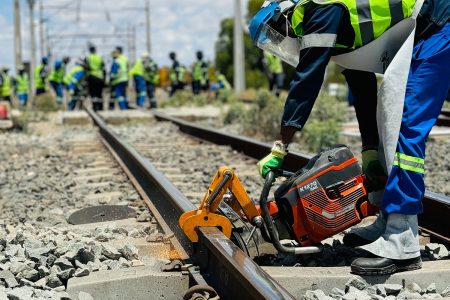
The proposed rehabilitation covers track condition assessments, sleeper and rail replacement, ballast cleaning and replacement, track geometry restoration, overhead traction equipment and signalling systems.

Ageing timber sleepers on sections of the general freight and mineral corridors would be replaced with prestressed concrete sleepers. Rail replacement would address sections affected by fatigue damage, wear and other defects, with jointed track converted to continuously welded rail where applicable.

Ballast cleaning and replacement would address deterioration of the track bed, while tamping and dynamic stabilisation would be used to restore track geometry following rehabilitation.

The programme also provides for the rehabilitation of overhead traction equipment, including the inspection, testing and replacement of deteriorated catenary and contact wires, support structures, insulators and tensioning equipment.

Sections requiring complete overhead equipment reconstruction would undergo mast erection, wire installation, tensioning and commissioning, coordinated with train operations on the affected corridors.

Signalling improvements would range from the rehabilitation of existing relay-based interlockings and trackside equipment to the installation of modern electronic interlocking systems on higher-priority corridor sections.

Associated works include the installation and commissioning of point machines, track circuits, relay cabinets and lineside signals, together with cable replacement in areas affected by theft.

Bridge and culvert rehabilitation may include structural repairs and strengthening, replacement of deteriorated bridge decks and bearings, corrosion protection and drainage improvements.

Linking Infrastructure Rehabilitation to Operational Performance

In addition to physical infrastructure improvements, the proposed programme is intended to strengthen Transnet’s operational performance through performance-based maintenance management, predictive maintenance technology, improved train scheduling and network control.

Measures to reduce unauthorised and emergency possessions are also envisaged to improve network capacity and service reliability.

The first phase would use the World Bank’s Program-for-Results financing approach, under which disbursements are linked to the achievement of defined results.

Proposed performance indicators include the kilometres of track rehabilitated, improvements in the Track Quality Index, removal of speed restrictions and train-slot reliability, measured against agreed departure and arrival parameters.

The programme also supports South Africa’s open-access rail framework through improvements to network access and slot-allocation procedures, dispute-resolution arrangements and operational support for private train operating companies.

One of the proposed indicators would measure the combined share of freight moved and train-kilometres operated by private train operating companies.

Rail-Port Connectivity

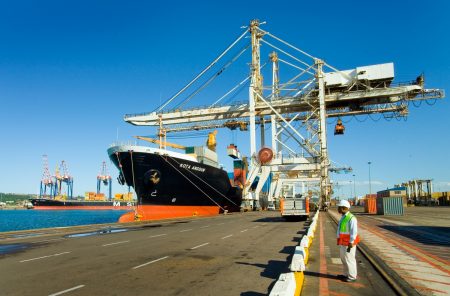
Although the first phase includes investment in port infrastructure, improvements at the interface between the railway network and port terminals are also envisaged.

At Durban, Cape Town and Gqeberha, proposed interventions include the rehabilitation of terminal railway tracks and crossings, improvements to rail-port gate interfaces and upgrades to intermodal transfer points.

These works are intended to improve the movement of freight between railway services and port terminals, supporting the programme’s objective of restoring competitive rail services for freight moving to and from South Africa’s ports.

Programme Preparation and Implementation

The draft assessment identifies occupational health and safety, infrastructure security and environmental management as considerations that will need to be addressed during implementation.

These include the risks associated with construction activities on operating railway lines, cable theft and infrastructure vandalism, and the handling and disposal of hazardous materials generated during track rehabilitation.

The proposed first phase is confined to the rehabilitation of existing infrastructure within established railway and port footprints. It does not include new railway alignments, greenfield development or large-scale land acquisition and resettlement.

The assessment also identifies measures to strengthen contractor oversight, infrastructure security and environmental and social management, which are to be incorporated into the programme’s implementation arrangements.

The draft will be subject to stakeholder consultation and revision before appraisal, with the proposed rehabilitation activities forming part of the wider SPRINT programme to improve the operational and financial performance of South Africa’s freight logistics system.

Read the full draft here: https://documents.worldbank.or...


Footnote

Citation

Aritua, Bernard.

P512358 – Draft Environmental and Social Systems Assessment (ESSA) – South Africa Port and Rail Infrastructure Transformation P4R (English). Washington, D.C. : World Bank Group. http://documents.worldbank.org...

Related News Articles