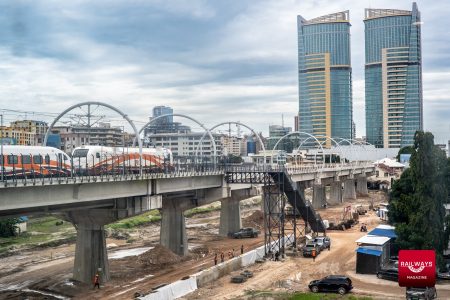
The USD 100 million approval identifies funding for rolling stock and operational equipment for Kano–Maradi Phase II. For manufacturers and suppliers, it is a development worth tracking as the project’s equipment requirements and procurement arrangements become clearer.
EBID has not announced a tender, equipment quantities or a supplier-selection timetable in this statement.
- EBID approved the USD 100 million facility on 28 September 2026
- Funding is earmarked for rolling stock and operational equipment for Phase II
- The Kano–Maradi standard-gauge railway will connect northern Nigeria with Niger
- EBID puts the project’s length at 393 km
- An earlier USD 180 million line of credit to Mota-Engil Nigeria was approved in April 2025
The ECOWAS Bank for Investment and Development (EBID) has approved a USD 100 million facility to acquire rolling stock and operational equipment for Phase II of the Kano–Maradi Standard Gauge Railway Project in Nigeria. The decision was taken at the Board’s 101st Ordinary Meeting in Lomé, Togo, on 28 September 2026.
The announcement does not identify the borrower for the new facility or give a date for signing the financing agreement.
EBID says the rail financing is intended to strengthen transport links and facilitate trade and mobility. It forms part of four operations totalling USD 390 million approved at the meeting, covering transport, energy, mining and climate-smart agriculture across West Africa.
Two facilities concern Ghana: USD 50 million for MOSL Limited to support petroleum-product supply and USD 230 million for Azumah Resources Ghana Limited to develop the Black Volta Gold Project. A further USD 10 million will support the pilot phase of the West Africa Initiative for Climate-Smart Agriculture (WAICSA) in Ghana, Senegal and Togo, promoting resilient agricultural practices and wider access to agricultural finance.
Dr George Agyekum Donkor, EBID’s President and Chairman of the Board of Directors, said the investments reflected the bank’s focus on projects with tangible economic and developmental impact. He said the operations would support productive activity, regional value chains, trade, private-sector participation and employment.
The approvals fall under EBID’s Growth, Resilience and Optimisation Strategy 2026–2030.
Earlier support for Kano–Maradi
EBID’s involvement in the railway also received recognition at the Sustainable Finance Awards 2026 in Karlsruhe, Germany. The bank received the Outstanding Sustainable Project Financing award at the ceremony held alongside the Global Sustainable Finance Conference on 27–28 August.
Arshad Rab, Chairman of the International Council of Sustainability Standards for Value-Driven Financial Institutions, said EBID’s support illustrated the role regional development finance institutions can play in economic transformation and connectivity.
The bank previously approved a USD 180 million line of credit to Mota-Engil Nigeria in April 2025 to co-finance Kano–Maradi. The railway is intended to connect northern Nigeria with Niger, with EBID citing improved passenger and freight movement, lower transport costs and stronger regional trade among its expected benefits.
In its 10 September 2026 announcement, EBID said the 393 km standard-gauge line was expected to be completed by the end of the year. It projected daily traffic of 9,300 passengers and 3,000 tonnes of freight.