The launch is built around the migration from GSM-R to FRMCS, which UIC described at the event as the first step for operators in building a digital foundation.
How far scenario-based solutions of this kind are taken up will depend on operators' own FRMCS migration plans and on progress in standardising AI applications, which UIC identified as increasingly important.
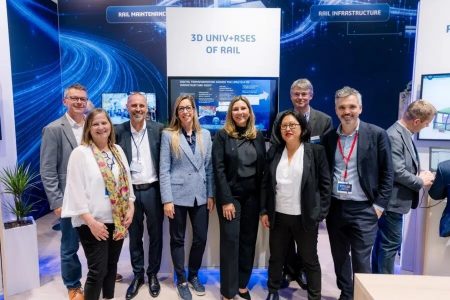
Huawei unveiled Intelligent RAIL 2.0, a new generation of its digital and intelligent solutions for the rail industry, at InnoTrans 2026 in Berlin, held from 22 to 25 September. Intelligent RAIL 2.0 comprises 20 scenario-based solutions covering three areas: construction, passenger and freight transport, and facility and equipment maintenance.
Huawei said the solutions are developed jointly with partners, with Huawei concentrating on communication and digital platforms and its partners on industry applications, so that modular solutions can be combined to suit a customer's specific business scenarios. The company presents the launch as the next stage of its "intelligent RAIL" strategy, which sets out four aims: railway safety (Reliable), efficiency (Automated), integrated services (Integrated-serviced) and long-term evolution (Long-termed).
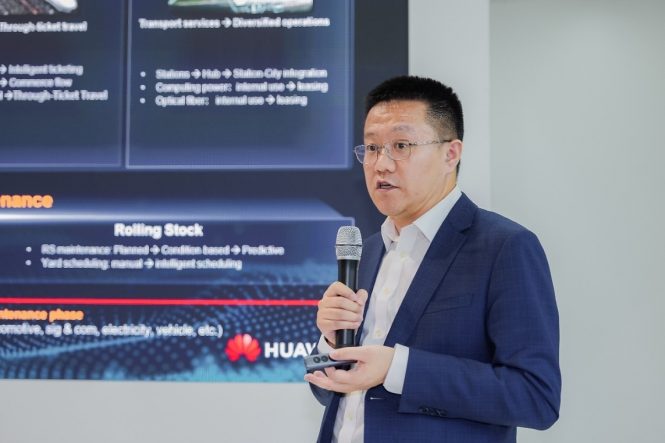
In his keynote, Raymond Zuo, President of Huawei's Smart Rail BU, set out the trends the company is designing for. Infrastructure will move from GSM-R to FRMCS, equipment maintenance will shift towards condition-based and predictive maintenance, freight will develop towards an end-to-end, service-oriented logistics model that includes multimodal transport, passenger services will move towards seamless travel, and engineering construction will make greater use of digital and intelligent technologies to improve safety and operational efficiency.
The launch was attended by the International Union of Railways (UIC) and the International Association of Public Transport (UITP). Jean-Michel Evanghelou, Director Digital Systems & Innovation, and Financial Control & Project Operations at UIC, said FRMCS would be the first step for rail operators to build a solid digital foundation, and that AI applications would continue to integrate into the core systems of the rail industry, making the standardisation of these applications increasingly important.
UITP Secretary-General Mohamed Mezghani also attended. Lidia Signor, Head of Multimodal Transport at UITP, spoke on "Global Metro AI Intelligence and Automation" and presented "AI-Driven Smart Rail Transport", a research report published by UITP with the China Association of Metro (CAMET) on the use of AI in metro construction, operation and maintenance.
Huawei says it has served more than 50 major railway customers and over 300 urban rail lines worldwide, covering more than 180,000km of track.