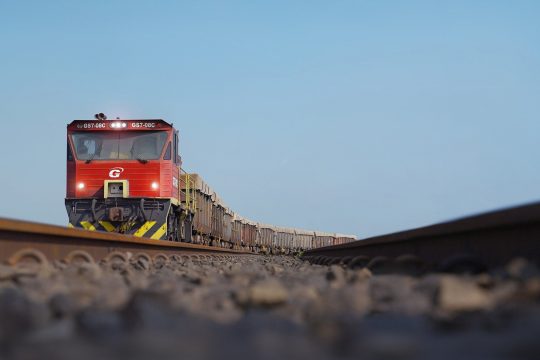
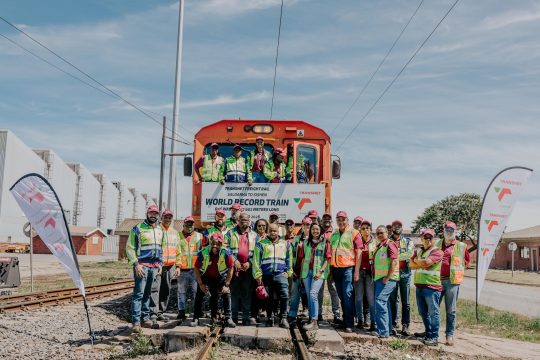
Ctrack places the rail recovery within efforts to restore capacity and rebalance road and rail freight, and its report points to concluded access agreements, private-sector partnerships on access and maintenance, and a Budget Facility for Infrastructure pipeline of 17 projects, about half of them road and rail.
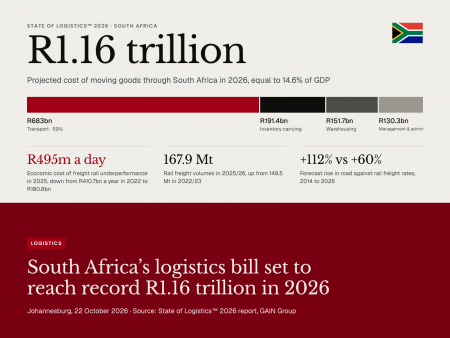
Road carries about 84% of South African freight payload in Ctrack’s assessment, and the report links higher road transport costs to renewed government focus on moving cargo back to rail.
- Ctrack’s Transport and Freight Index report, published on 27 October 2026, covers the third quarter of 2026.
- Ctrack’s rail freight component rose by 3.1% in the third quarter compared with the second, after a 7.9% decline in the second quarter.
- The rail component was 7.7% higher in September 2026 than in September 2025 and 2.6% higher than in August 2026.
- The overall index stood at 122.2 against a 2016 base of 100, up 0.2% on the second quarter.
- Road freight was the only component to contract, falling by 2.7% quarter-on-quarter.
- Ctrack says 11 private train operating companies have concluded access agreements with the Transnet Rail Infrastructure Manager and are preparing to start operations.
The rail freight component of Ctrack’s Transport and Freight Index rose by 3.1% in the third quarter of 2026 compared with the second quarter, recovering part of the previous quarter’s 7.9% decline. The report’s summary table records rail freight 7.7% higher in September than in September 2025 and 2.6% higher than in August.
Ctrack published its third-quarter report on 27 October. The overall index stood at 122.2, with 2016 as the base year of 100. It increased by 0.2% quarter-on-quarter, while the September reading was 1.8% above September 2025. Road freight was the only component to contract during the quarter, falling by 2.7%.
Rail Reform and Investment
Ctrack says restoring railway capacity and improving port efficiency remain central to South Africa’s logistics reforms. It notes that the rail recovery follows a low second-quarter base and expects the effects of reversing underinvestment and opening the network to private operators to take several years.
The report says the 11 private train operating companies allocated mainline slots in 2025 had concluded access agreements with Transnet Rail Infrastructure Manager and were preparing to start operations. It identifies local partnerships and progress on access and maintenance as factors that could improve network efficiency over the medium term.
Ctrack also describes a funding pipeline being assessed through the Budget Facility for Infrastructure. It says 17 projects entered the pipeline during the first two submission windows of 2026/27, with road and rail projects accounting for about half of the projects. These remain at different assessment stages, with successful projects to be considered for contingency-reserve funding. The mechanisms described include fiscal allocations, blended finance, de-risking instruments incorporating private funding and public-private partnerships.
Road Costs and Port Performance
The report puts road’s share of South African freight payload at approximately 84%. It says road payload was broadly unchanged over the year to date compared with the same period in 2025, despite quarterly declines in both the second and third quarters. Higher fuel and financing costs remained pressures on demand.
Sea freight increased by 6.3% quarter-on-quarter after a 9.3% decline in the second quarter. Ctrack records a 13.8% quarterly increase in container throughput across South African ports and a 4.0% increase in total cargo handled, excluding vehicles. These are separate measures from the sea freight index component.
The remaining components also improved quarter-on-quarter: storage and handling rose by 7.3%, pipeline transport by 3.0% and air freight by 2.4%. Storage and handling nevertheless remained 3.9% below its September 2025 level.
Ctrack warns that elevated fuel prices and weaker demand leave the logistics sector exposed to near-term risks. Chief Executive Officer Hein Jordt says further pressure on the wider economy could affect transport and logistics during the remainder of 2026, given the sector’s dependence on fuel.