Anura Partners Launches Tracks to Prosperity Volume 2: The Future of Transnet’s Non-Core Assets Non-Core Assets
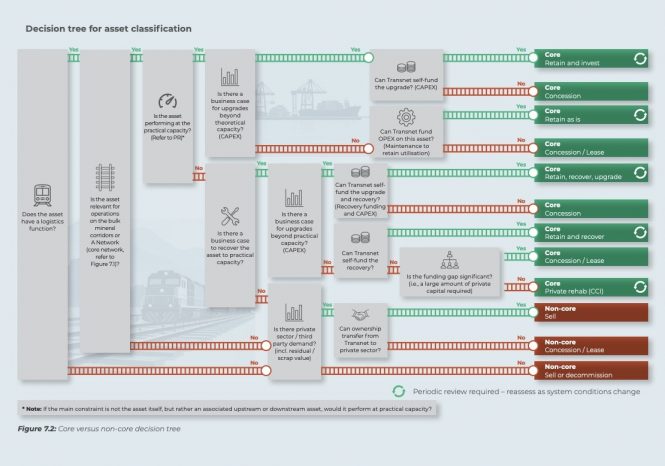
Anura Partners’ decision tree puts every asset on Transnet’s register through the same sequence of yes-or-no questions. An asset that does not serve a logistics function, or is not part of the core network, is non-core, and the remaining question is how to release it.
Disposing of non-core assets is one of Transnet’s commitments under National Treasury guarantees, which comprise the original R47 billion guarantee of December 2023 and a further R145.8 billion approved in 2025. The report proposes an Independent Transaction Office with the authority to sign transactions.
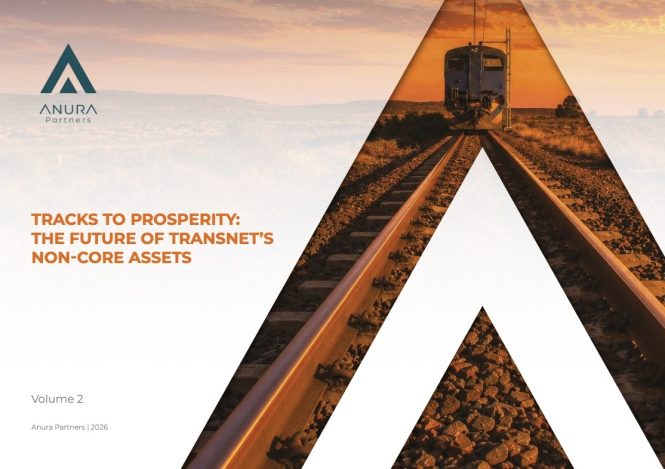
- Anura Partners launched Tracks to Prosperity, Volume 2: The Future of Transnet’s Non-Core Assets on 22 October 2026 at its Melrose Arch office.
- The report proposes a decision tree that sorts Transnet assets by logistics function and core network status before performance and funding are considered.
- National Treasury approved a further R145.8 billion in guarantees in 2025, after the original R47 billion guarantee in December 2023.
- The report says the bulk mineral corridors and the core network carry 95% of freight potential on 37% of route length.
- It scores train operations at 50% against an 85% threshold and rail networks at 65% against 75%.
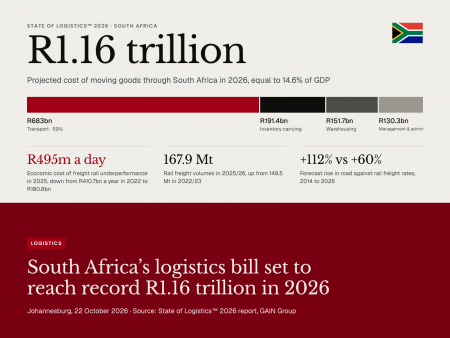
- Freight volumes are estimated at 171 million tonnes in 2026/27, against viable demand of 262 to 280 million tonnes.
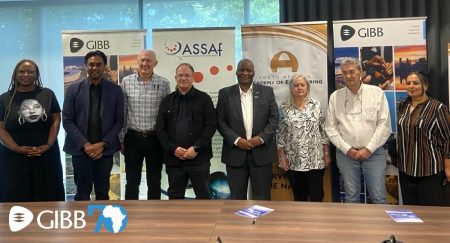
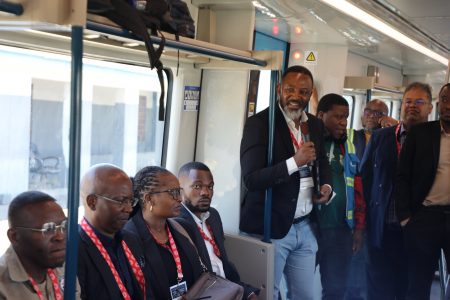
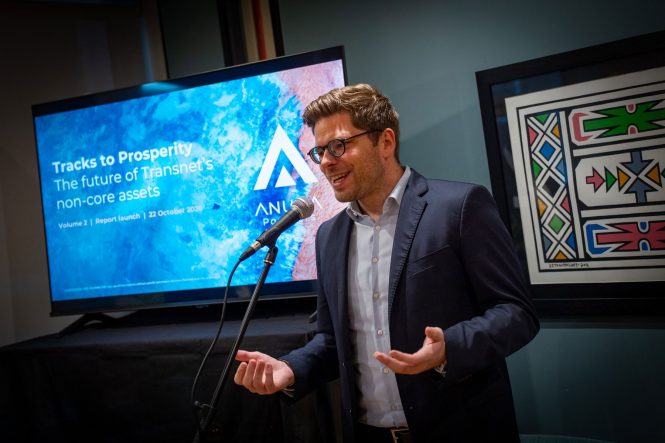
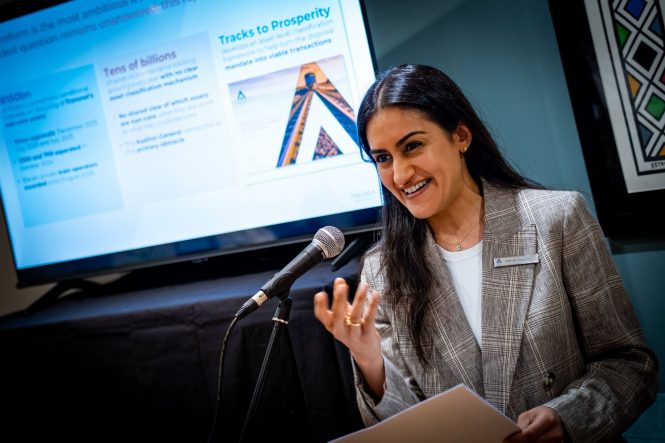
On 22 October, Anura Partners launched Tracks to Prosperity, Volume 2: The Future of Transnet’s Non-Core Assets at its Melrose Arch office, to a room of operators, financiers, policymakers and sector experts.
The report asks one question: which of Transnet’s assets are non-core? The question is simple, but nobody has published an answer.
“This report is meant to spark a discussion,” said Dr Maximilian Matschke, Anura’s Managing Partner. It does so with a framework the sector can test on its own assets and refine.
A binding condition with no definition
After the original R47 billion guarantee in December 2023, National Treasury approved a further R145.8 billion in 2025. Disposing of non-core assets is one of Transnet’s commitments under these guarantees, yet there is no asset-level definition of non-core. The Auditor-General names this as the primary obstacle to execution.
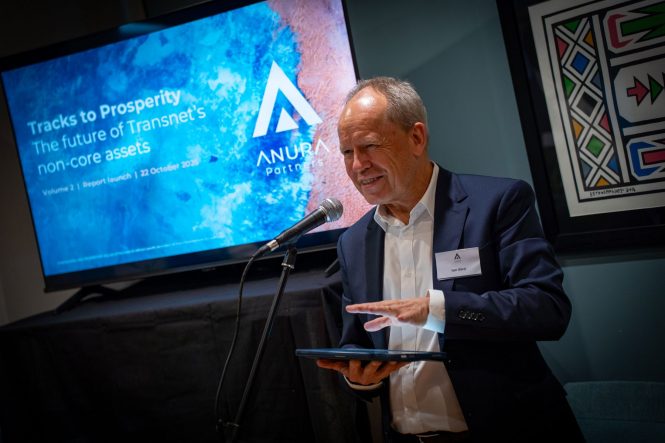
“To my knowledge, there is no publicly available list of Transnet’s non-core assets,” said Ian Bird of Business for South Africa (B4SA). “That is what happens when a reform programme outruns the institutional frameworks needed to implement it.”
The result is a disposal programme that targets about R1 billion from residential property, a fraction of the value in the wider portfolio.
Assets left undecided do not stand still: they deteriorate, and each year without a list costs value.
A freight test first, a funding test second
The bulk mineral corridors and the core network carry 95% of freight potential on 37% of route length. The definition question lives in the rest: feeder and short lines, and the yards, property and rolling stock around them.
At the centre of the report is a decision tree Anura developed to sort these assets. The sector has had no shared test for what Transnet should keep and what it should let go, and the tree is designed to be one. It is a short sequence of yes-or-no questions that every asset on the register passes through in the same order, left to right, so that the same asset always gets the same answer. Two questions come first. Does the asset serve a logistics function? Is it part of the core network? A no to either makes it non-core, and the only question left is how to release it. Two yeses make it core, at least to start. Only then do performance and funding come in. They decide how the asset gets fixed and who pays for it, never whether it stays.
Two assets show the tree at work. The Carlton Centre carries no freight, so it is judged on logistics function and market demand. It belongs with developers. The Ermelo to Richards Bay coal line is the export artery, recovering from a 30-year low of about 48 million tonnes in 2023. It stays core. If Transnet cannot fund the repair, private rehabilitation can, and agreements with exporters are under negotiation.
Investors read the process before the asset
Private investors have the appetite, but investable transactions are scarce.
The right sale pays. Bird pointed to Transnet’s sale of a stake in the Durban Container Terminal: a R12.5 billion one-off gain that turned a R1.9 billion loss into a R4.6 billion profit.
Sequence matters as much as price. Transnet classified the V&A Waterfront as non-core, redeveloped it in phases from 1988, and sold it competitively in 2006 and 2007 for R7 billion. The 2016 to 2017 branch-line concessions skipped those steps. Credible bids never reached award, and the lines kept decaying.
The report’s remedy is an Independent Transaction Office with the authority to sign, not only advise, as the IPP Office did for power, backed by a visible pipeline and standard documentation.
Fix the weakest link first
The report scores each link in the freight chain against the top of its standard band. Train operations run at 50% against an 85% threshold, the widest gap. Rail networks run at 65% against 75%.
Track feeds trains and trains feed ports, so no link can outperform the weakest one ahead of it. Today that link is the operator. Network upgrades cannot turn into freight volume until the trains run.
Volumes are moving the right way: from 142 million tonnes projected in 2023 when the National Logistics Crisis Committee was established, to a latest estimate of 171 million in 2026/27. Viable demand is 262 to 280 million, and closing that gap falls to the operator.
A place to start
Whether the sector takes up the framework is now the open question. The report offers a method for drawing up the list, not the list itself, and invites operators, investors and officials to test it against their own assets. For a reform programme that has lacked a common starting point, that may be the most useful thing it puts on the table.
The report and decision tree are available at www.anura.partners/publication for readers who want to run their own assets through it.