The World Bank Group’s assessment links the commercial prospects of Burundi’s Musongati nickel fields to the development of the Tanzania–Burundi standard gauge railway. The proposed connection to Tanzania’s rail network and the port of Dar es Salaam could support mineral and agricultural exports, stimulate economic activity along the corridor and provide access to wider markets. However, the report makes these potential benefits conditional on mining investment materialising.
For railway developers, contractors and financiers, the report highlights the importance of coordinating transport investment with mining development, electricity supply and supporting infrastructure. Its recommendations for expanded hydropower, private-sector energy partnerships and improved mining logistics identify requirements that extend beyond railway construction. The existing US$696.41 million African Development Bank financing approval provides a railway funding foundation, while the report emphasises the need for reliable infrastructure, predictable regulation and local supplier development to support Musongati’s commercial potential.
The World Bank Group’s Country Climate and Development Report for Burundi, dated October 2026, recommends upgrading rail and energy infrastructure to support development of the Musongati nickel fields and other exports. Its target is that new or upgraded energy infrastructure should meet 100% of the energy capacity Musongati’s mining operations require by 2050. Against this action the report’s table records US$696.41 million, marked as allocated by the African Development Bank. The amount matches the bank’s December 2023 approval of US$696.41 million for the Tanzania–Burundi standard gauge railway, made up of US$98.62 million in grants to Burundi and US$597.79 million in loans and guarantees to Tanzania, so it is existing financing and not a new commitment.
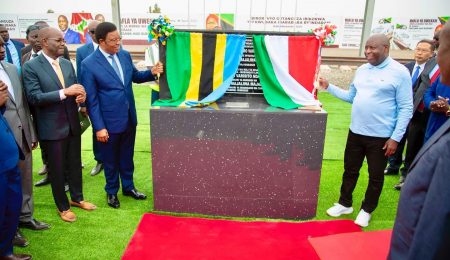
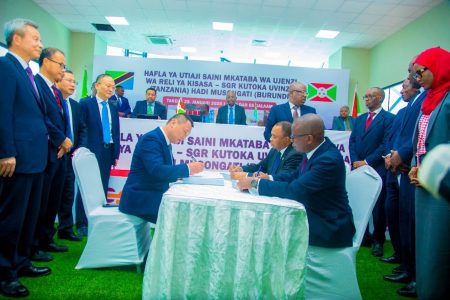
The railway enters the report as part of the case for Musongati. Burundi, it says, has committed to build a line linking the country to western Tanzania, with the aim of opening commercial possibilities along the economic corridor that go beyond mineral and agricultural exports. The standard gauge railway will connect to Tanzania’s existing network and provide access to the port of Dar es Salaam. The report says the line could contribute to national GDP growth and, subject to mining investments materialising, allow Burundi to access additional resources for social and economic development.
The World Bank Group treats Musongati as a possible regional development pole, with demand for mining services and goods reaching across the border into Tanzania. It describes the deposit as the “best catalyst for future economic development in Burundi” and notes that a nickel manufacturing plant in the designated Burundi Special Economic Zone could draw on the raw material. Among the power sources it mentions is a 15-megawatt hydroelectric plant inaugurated at Rumonge in 2022 with support from the Chinese government, which it says has the potential to serve Musongati.
On energy, the report recommends public–private partnerships between mining companies and regional or local hydropower and solar providers, so that mines such as Musongati can draw affordable, clean power and sell surpluses back to the grid. Expanded hydropower should be directed to mining areas in place of more expensive fossil fuels. For mining logistics, it calls for electrified and decarbonised transport solutions, together with better water management and treatment.
The report puts mining and quarrying at 0.5% of Burundi’s GDP in 2018 and identifies inadequate transport, energy and water supply infrastructure as constraints on large-scale mining, alongside governance challenges and inconsistent application of regulations. Burundi’s revised mining framework rests on Law No. 1/19 of 4 August 2023, which the report says sets minimum State participation of 16% in the share capital of operating companies for large- and small-scale mining. The World Bank Group calls for predictable, transparent and consistent implementation of the Code, stronger capacity to negotiate and administer mining contracts, publication of contracts and environmental and social safeguards aligned with international benchmarks.
Musongati’s development is expected to create demand for small and medium-sized suppliers of mining inputs, technology, equipment, catering, transportation and logistics. The report lists prerequisites for the investment that include stronger public–private partnership legislation, energy-sharing agreements between mining companies and service providers, technical support for suppliers managing environmental and social impacts, and workforce development that includes women and other vulnerable groups, supported by local content policies. It also recommends community development agreements, transparent revenue-sharing formulas and participatory monitoring, so that mining generates jobs, skills and infrastructure in host areas.
Read the full report