The paper gives governments, regulators and financiers a single reference for building railways that deliver on their environmental promise, from a revitalised Union of African Railways and common technical standards to bond finance, carbon credits and ring-fenced maintenance funds. Its recommendations are intended to feed into the African Union's Continental Infrastructure Policy.
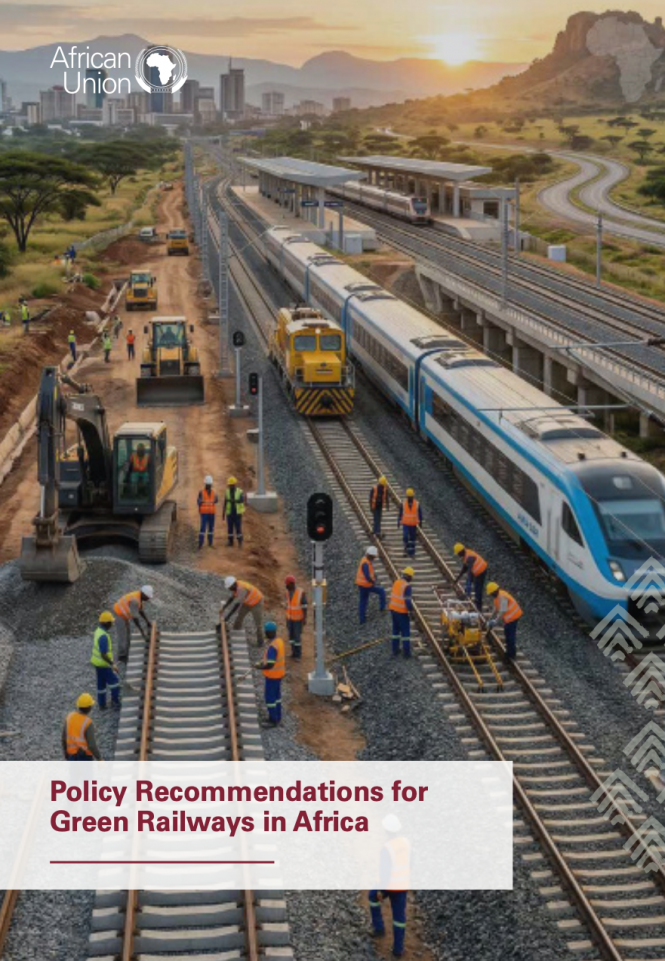
- GIZ has prepared 40 Policy Recommendations for Green Railways in Africa under its Support to PIDA programme for the African Union.
- The recommendations are grouped into eight building blocks, from governance and interoperability to financing and skills.
- The paper says about 30% of Africa's tracks are inoperative or obsolete, and most of the working network is single track and not electrified.
- It recommends revitalising the Union of African Railways as a decentralised pan-African agency, akin to the European Union Agency for Railways.
- It finds that brownfield projects cost on average about 25% to 50% as much as greenfield main lines.
- It proposes financing railways through carbon credits under Article 6 of the Paris Agreement and through infrastructure and green bonds.
Africa's railways are usually sold as the green option, but a new policy paper prepared for the African Union argues that the environmental case for rail only holds when the conditions around it are right. Its 40 recommendations say comparatively little about trains and a great deal about institutions, standards, planning and money.
The Policy Recommendations for Green Railways in Africa were prepared by GIZ under its Support to PIDA programme, the Programme for Infrastructure Development in Africa whose political steering the African Union coordinates. The recommendations will form part of the Continental Infrastructure Policy. It condenses the larger Railway Source Book for Africa, which drew on a literature review, continent-wide consultations with regional institutions, public railway companies, railway associations and corridor authorities, and a review of international practice.
The starting point
The paper is frank about where the sector stands. About 30% of Africa's tracks are inoperative or obsolete, and most of the working network is single track and not electrified. Sub-networks of different gauges, safety rules and operating procedures limit how far trains can run. Governments have long favoured roads, and because most states struggle to raise capital at an affordable cost, infrastructure has relied on concessional finance and international financial institutions. Limited money for maintenance, the paper says, has produced structural underinvestment.
It groups its response into eight building blocks: governance and regulation, harmonisation for interoperability, integration with spatial planning, sustainable development, modern and efficient infrastructure, financing, intermodality, and railway expertise.
Modal shift does not happen by itself
The paper's central argument on sustainability is that rail's main contribution comes through modal shift, and that shift is not natural under current conditions. "Promoting railways is not an objective in itself," it states. Rail should be promoted because it is more energy-efficient and has less environmental impact than other modes.
Getting traffic onto rail requires policy as well as track. The paper recommends targeted incentives for rail and intermodal transport, citing the EU's Combined Transport framework under Council Directive 92/106/EEC and an incentive at DP World's Southampton Port in the UK. It calls for stricter enforcement on road transport through axle load controls, vehicle inspections, plate recognition and speed cameras, and for taxes and regulatory constraints on trucking where necessary, pointing to Kenya's requirement that inland containerised shipments from Mombasa travel by rail.
On traction, the paper accepts that electrification remains the long-term objective but notes that unreliable electricity supply, energy deficits and frequent outages make it difficult in the short to medium term. In the meantime, it recommends research and pilot projects in hydrogen, battery-electric, liquefied natural gas and biofuel traction, drawing on experience elsewhere, particularly in Europe.
Counting the carbon
Rail's environmental benefits are hard to prove in Africa because data on mobility, freight flows and vehicle types is limited. The paper recommends investment in data collection, standardised metrics for emissions and external costs, with the EU's Handbook of External Costs as a model, and cooperation with international financial institutions and the EU on quantification.
Once savings can be measured, they can be turned into money. The paper proposes using them to seek carbon credit and climate fund finance, including through Article 6 of the Paris Agreement, working with rating agencies on validation and looking for buyers willing to pay in advance for future credits to fund construction. It also suggests studying subsidies for rail operations in compensation for their emission savings compared with less efficient modes.
With Africa exposed to some of the world's highest temperatures and more frequent natural disasters, the paper wants climate-resilient design built into continental standards and maintenance strategies adapted to new conditions.
A continental agency and separated railways
On governance, the paper finds that the African Union lacks a strong institutional arm for railways. It recommends revitalising the Union of African Railways (UAR) as a decentralised pan-African agency, akin to the European Union Agency for Railways, to lead technical work, set common standards and safety measures, supervise regulators and coordinate cross-border operations.
It also questions the national monopoly model, in which one public company builds and manages infrastructure, runs passenger and freight services and maintains rolling stock. It recommends that the more established railways move progressively towards vertical and horizontal separation, with distinct freight and passenger business units, and a phased opening of markets to competition through open-access policies. Smaller markets could keep integrated public railways until conditions allow reform, while finding ways to let licensed operators from other countries run on their networks. National safety and economic regulators should be introduced or strengthened, and for smaller railways with a public monopoly, simplified monitoring bodies or contract programmes can do the job, as in Morocco.
To make rolling stock easier to finance and lease, the paper recommends that states ratify the Luxembourg Rail Protocol to the Cape Town Convention and the General Contract of Use for Wagons (GCU), and adopt the URVIS identification system for tracking rolling stock.
Standards that fit each network
The paper notes that standard gauge has been adopted as Africa's preferred gauge, but that key interoperability parameters remain undefined, leading to discrepancies between recent projects. It recommends African Technical Specifications for Interoperability for infrastructure, rolling stock and operations, developed by a working group led by the revitalised UAR and modelled on Europe's, and treated as living documents.
It also recommends tailored domestication strategies for each country or region. Some countries, especially in SADC, have continued building to their existing parameters because new standards clash with their infrastructure, and the paper suggests a strategy that keeps SADC's narrow gauge network functional while providing for future transformation. Where full harmonisation is not realistic in the short to medium term, adaptable rolling stock is put forward as a cost-effective route to interoperability, including variable gauge technology from TALGO and CAF and Switzerland's PROSE EV09-EV18, and locomotives with multiple traction systems.
Borders matter as much as gauges, some of the stakeholders consulted stressed that critical problems at international borders stem from inefficient crossing procedures rather than technical interoperability. The paper recommends one-stop border posts for rail, built on harmonised laws, simplified procedures, single-window ICT systems and proper border facilities.
Brownfield before greenfield
Before committing to greenfield construction, governments are urged to assess the level of service and capacity actually needed, the condition of the existing line, interoperability with connecting networks and their own capacity to operate and maintain a new railway. The paper puts the question plainly: does it make sense to build a new standard gauge line in a narrow gauge network?
It also calls for independent audits of feasibility studies, so that projects do not start on unrealistic forecasts, together with detailed designs checked by government experts or external auditors, quality control during construction, warranties, penalties for contractors and ring-fenced funding for maintenance. Security measures against looting and investment in anti-theft technology are included in the maintenance recommendations.
Matching finance to the life of a railway
Loans are the main source of debt finance for African railways, and the paper finds that the repayment terms often do not match the long timelines of rail projects and that they carry high interest rates. It recommends developing infrastructure bond markets, including green bonds, and following the approach used in Brazil of using loans for construction risk and moving to bonds once a line is operating.
To make projects more bankable, it proposes standardised eligibility criteria, feasibility studies subject to due diligence, equity-to-debt ratios above the standard 20/80 to show sponsor commitment, early involvement of international financial institutions and export credit agencies, and partial credit guarantees from those institutions and climate funds.
The paper argues that the problems of the 1990s and 2000s concessions point to unsuitable PPP models rather than a reason to abandon PPPs. It suggests separating infrastructure PPPs, aimed at civil works specialists, from operations PPPs such as franchises or service contracts, tested first in countries with stronger institutions. For operations and maintenance, it recommends Railway Infrastructure Funds or other ring-fenced financing, drawing on African experience with Road Funds, and for passenger services a transparent framework for Public Service Obligation compensation.
Equipment and skills
The paper describes the state of rolling stock as dire. It recommends that the UAR, the regional economic communities and international financial institutions coordinate joint procurement to gain economies of scale, with rolling stock transferred to railways or leased through rolling stock companies. It notes that in sub-Saharan Africa there are almost no maintenance facilities capable of large repairs outside South Africa, where Transnet has depots across the country, and that manufacturing is concentrated in South Africa and limited to Cape gauge rolling stock. Its response includes incentives for local manufacturing and for international manufacturers to set up plants for standard gauge wagons and locomotives in Africa.
On skills, it recommends skill-transfer clauses in concession and EPC contracts, monitored and backed by penalties, knowledge-sharing platforms drawing on South Africa and Morocco, standardised training programmes, certification agencies for railway professionals and investment in Centres of Excellence for research.
What the paper adds up to
The recommendations are presented as guidelines, with the Railway Source Book as the detailed reference behind them. Taken together, they make the case that green railways in Africa depend less on the choice of locomotive than on the rules, standards, planning discipline and financing structures that decide whether a line is built well, maintained and used.
Get the Policy Recommendations for Green Railways in Africa hereWritten by Phillippa Dean