Why it Matters
Botswana Railways is facing a freight capacity problem rather than a demand problem. With volumes sitting at around 950,000 to 1 million tonnes a year against an estimated minimum operating requirement of 1.4 million tonnes, the railway’s ability to return locomotives and wagons to service will be central to whether it can recover traffic from road.
The turnaround effort also has wider regional significance. Botswana Railways sits on important north-south and east-west corridor ambitions, including the Trans-Kalahari Railway, Mmamabula-Lephalale and Mosetse-Kazungula-Livingstone links. Its asset recovery, strategic partner model and financial reporting backlog will directly influence its ability to participate in future corridor development.
Written by Phillippa Dean
In May, Botswana Railways appeared before the Parliamentary Standing Committee on Statutory Bodies and State Enterprises, where the state-owned railway outlined the severity of its operational, financial and governance pressures.
Botswana Railways is working to stabilise its freight business through a bridging plan centred on locomotive recovery, wagon availability, strategic partnerships and improved operating efficiency, as freight volumes remain below the level needed to cover costs.
The railway has been moving between 950,000 and 1 million tonnes of freight a year, against an estimated minimum operating requirement of 1.4 million tonnes. The gap has placed sustained pressure on the business, with the entity recording operating losses of around P90 million in 2021/2022, P45 million the following year, P40 million in 2023 and P60 million in 2024.
For Botswana Railways, the immediate challenge is not a lack of freight demand, but the limited availability of the assets required to move it. Trucks have taken over traffic that could otherwise be carried by rail, while the railway’s ability to recover that traffic depends on whether it can return enough locomotives and wagons to service.
Established in 1986 under the Botswana Railways Act, the entity’s mandate covers bulk freight, parcels and passengers. Its main line runs from Ramatlabama to Ramokgwebana, linking South Africa through Botswana to Zimbabwe, supported by branch lines to Sowa, Selebi-Phikwe and Morupule Coal Mine. Botswana Railways is expected to operate on a commercial basis and does not typically receive government subsidies.
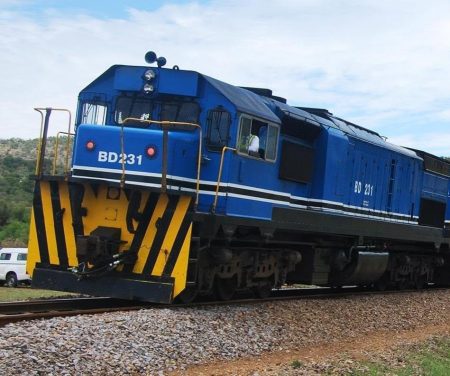
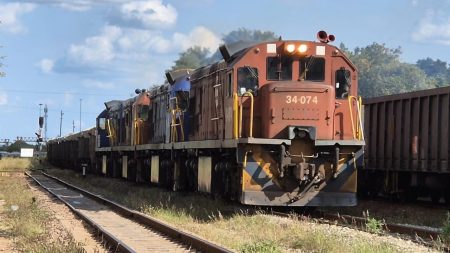
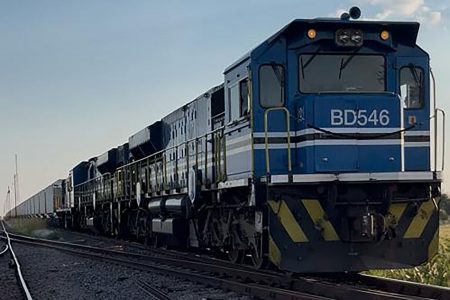
The scale of the constraint is visible in the fleet, with Botswana Railways reporting 31 locomotives, eight of which are currently operational, while effective available traction is closer to three locomotive equivalents. Wagon availability is also severely limited, with only 135 of the 1,155 wagons on the books currently in service.
When three locomotives are required to move one load, the railway is not gaining capacity; it is absorbing inefficiency. Botswana Railways has linked this problem to traction motor availability and the condition of older locomotives, including units acquired decades ago, as well as BD5 locomotives bought during the 2013/2014 recapitalisation period.
The current bridging plan is designed to break this cycle by returning traction and wagon capacity to the business. Botswana Railways is targeting between 10 and 15 locomotive equivalents over a five-month period, using leased locomotives, spare parts and traction motors from Namibia. The railway has indicated that 24 traction motors are coming from Namibia, with the first units expected to add progressively to available pulling power.
On the wagon side, the recovery programme is being driven by a combination of internal maintenance and customer-backed arrangements. Fuel wagons, salt wagons and soda ash wagons are being repaired through partnerships, while one freight owner is fixing 96 wagons in three batches of 32. The first batch is expected in May/June, followed by further batches in August/September and December.
Freight-owner support has become a practical response to the railway’s capital constraint. BOTASH is one example of customer-backed wagon maintenance, while oil tankers repaired by ARC at a cost of P10 million are now moving fuel through the Limpopo Corridor from Mozambique through Zimbabwe to the Francistown oil depot. Under this type of arrangement, partner capital is recovered through freight activity.
Botswana Railways is also engaging three strategic partners under longer-term structures. Where the railway does not have the funding to buy locomotives and wagons, the proposed model would allow partners to bring capital, purchase assets, and recover their investment over 20 to 25 years through agreed freight arrangements similar to a PPP. Business and financial models have been completed, and contracts are under review.
Operational recovery will also depend on better performance across regional interchange points. Botswana Railways works with Transnet Freight Rail on the South African side and NRZ on the Zimbabwean side. At Mahikeng (formerly known as Mafikeng), where traffic moves into the South African network, locomotive availability and line capacity have affected movement further inland.
At Mahikeng, there has been some improvement, with locomotives available for Botswana Railways traffic increasing from six to 10, while operating lines have improved from three out of 10 to six out of 10. The purpose is to reduce turnaround times, which remain a major performance concern.
Botswana Railways works on a client expectation that wagons should complete a full cycle within 14 days. In some cases, cycles have extended beyond 30 days, reducing utilisation and weakening the railway’s ability to compete. To address this, Botswana Railways is trialling through-working arrangements. Under this model, South African locomotives can come to Gaborone to collect loads when Botswana Railways lacks locomotives, while Botswana Railways can also move through the South African network and deliver coal beyond Mahikeng when required.
The freight recovery plan also shapes the future of passenger services. Passenger trains were suspended during the COVID period, and Botswana Railways has acknowledged interest in reinstating services. Short-distance possibilities include Lobatse-Gaborone, Gaborone-Mochudi and Tonota, along with possible Gaborone-area loops and radial services such as Phakalane-Mogoditshane-Gabane. Any reinstatement, however, would depend on freight stabilisation.
The longer passenger rolling stock remains idle, the greater the cost exposure becomes. Coaches are sitting in locations including Mahalapye and Lobatse, where they are losing value and are exposed to vandalism, including theft of copper cables. Returning those coaches to service may therefore be more expensive than originally expected.
Alongside the operational recovery, Botswana Railways is also dealing with a financial reporting backlog that sits directly against its wider turnaround effort. The railway has acknowledged a backlog of audited financial statements dating from 2019. Botswana Railways expects the 2025 audits to be available by September 2026.
With Botswana Railways seeking partner-backed capital, long-term commercial arrangements and PPP-style structures, the audit backlog is not just an administrative issue. Current and credible financial reporting will be important to support those negotiations and strengthen confidence in the turnaround process.
The same pressure is visible in the entity’s disputes and litigation, with Botswana Railways referring to P61 million in disputes linked to the gap between income and required payments for operating inputs such as fuel, cleaning, security and other services. The railway has also referred to risks around JTTM shares, including encumbrances linked to debt and litigation.
Although immediate recovery depends on the existing asset base, Botswana Railways is still pursuing longer-term network development as part of its strategic direction. The railway is pursuing north-south and east-west corridor options to reduce reliance on a largely one-line network and expand access to regional markets.
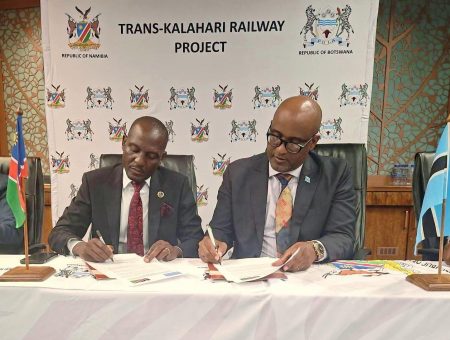
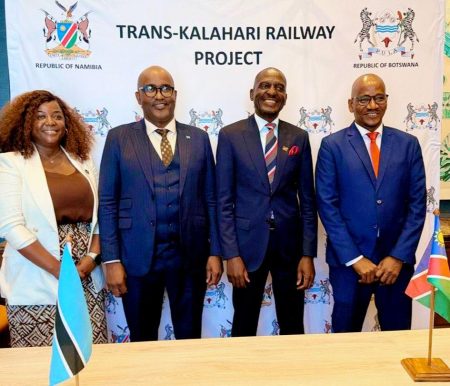
The Trans-Kalahari Railway would connect Botswana from around Serule, through the Orapa area and towards Namibia around Gobabis, reaching the Port of Walvis Bay. The Mmamabula-Lephalale project is intended to link the Mahalapye-Mmamabula area towards Richards Bay and Maputo, with coal traffic to Richards Bay identified as a shorter-distance opportunity. The Mosetse-Kazungula-Livingstone link would strengthen access towards Zambia and, eventually, the DRC market.
These projects are being pursued through PPP financing because the national balance sheet cannot carry the full cost of the major rail links. The Trans-Kalahari Railway feasibility study is expected to conclude in June, after which Botswana Railways intends to approach the market for partners. Mosetse-Kazungula has completed pre-feasibility and is now in feasibility, with completion targeted by the end of the year, before development partners are sought. Mmamabula-Lephalale has experienced delays but is expected to move forward soon.
Botswana Railways has indicated that it expects measurable progress by December, with the focus now on whether locomotive availability improves, wagons return to service, turnaround times shorten, freight volumes recover and the audit backlog is reduced.
If the bridging plan delivers working assets and measurable freight recovery, Botswana Railways will have a stronger platform to regain traffic from road, support future passenger reinstatement and participate more effectively in regional corridor development.