Ghana Defends Acquisition of Class 56 Locomotives and Freight Wagons

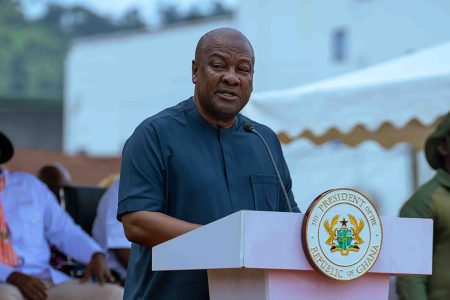
Ghana’s Ministry of Transport has defended the Ghana Railway Development Authority’s acquisition of two diesel locomotives and 20 freight wagons, following concerns raised by the NPP Minority Transport Committee.

According to the ministry, the condition and operational suitability of railway rolling stock cannot be assessed solely according to its age. Railway engineers consider factors including structural integrity, refurbishment quality, remaining fatigue life, reliability, availability, maintainability, tractive effort, axle load, route compatibility, spare-parts support, whole-life cost and expected commercial returns.

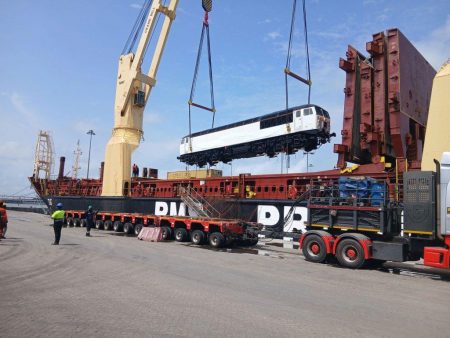
Before being exported to Ghana, the two British Rail Class 56 locomotives underwent heavy maintenance in the United Kingdom. The work included complete overhauls of the diesel engines, electrical traction equipment, traction motors and bogies, together with the renewal of the braking systems.

The locomotives were also fitted with GSM-R digital railway radio and other safety equipment required for operation on the UK mainline network. Worn mechanical components were replaced, after which the locomotives underwent testing and certification before export.

The suppliers have provided a five-year warranty against operational defects. Under routine and periodic maintenance programmes, the ministry expects the locomotives to provide at least 15 years of productive service before requiring major maintenance.

Maintenance and Spare-Parts Support

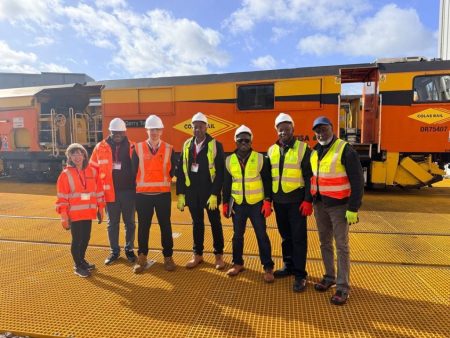
The ministry said British Rail Class 56 locomotives remain in commercial freight service in the United Kingdom, where they are operated by Colas Rail, DCRail and GB Railfreight. The locomotives are also operated in Hungary by Floyd Zrt.

Colas Rail uses Class 56 locomotives for Network Rail’s Rail Head Treatment Train programme under a five-year contract valued at approximately £58 million and running until 2030. DCRail operates the locomotive class for the transportation of aggregates, construction materials, industrial minerals and infrastructure-related cargo.

Based on their continued commercial operation, the ministry said spare and replacement parts remain available. The Ghana Railway Development Authority has made arrangements with suppliers to maintain approximately five years of spare-parts stock, particularly fast-moving components and consumables required for routine and periodic servicing.

Engineers have also arrived in Ghana to provide specialised practical training and technology transfer to GRDA technicians and engineers responsible for maintaining the locomotives and wagons.

Freight Rolling Stock Acquisition

The two Class 56 locomotives and 20 container wagons were acquired for approximately GH¢37.6 million, equivalent to US$3.18 million.

The ministry contrasted the acquisition with the previous procurement of two two-car PESA diesel multiple units for passenger services at a cost of US$14.67 million, or approximately GH¢164.7 million. One of the units, DMU 002, was refurbished.

Unlike the passenger DMUs, the Class 56 locomotives were acquired specifically for heavy freight operations and were not intended for passenger services. The PESA units were similarly not designed for heavy freight haulage.

The freight locomotives and wagons are intended to transport containers and industrial cargo between the Port of Tema and Mpakadan. The ministry said the acquisition was based on a value-engineering approach intended to secure proven freight capacity, begin commercial operations, generate revenue and develop local maintenance capabilities.

Tema-Mpakadan Freight Preparations

The Ghana Railway Development Authority has two reach stackers capable of loading and unloading containers from railway wagons. It also has five heavy-duty forklift trucks to support container and bulk-cargo handling, terminal operations and related logistics activities.

According to the ministry, this equipment provides the immediate lifting capacity required to begin freight operations. GRDA is also taking steps to procure two gantry cranes to complement the existing cargo-handling equipment and expand its longer-term operating capacity.

Freight demand on the Tema-Mpakadan corridor was assessed before financing was secured from the India EXIM Bank in 2016 for the construction of the railway infrastructure. Feasibility studies and traffic-demand assessments conducted as part of the multimodal transport system identified potential demand for freight traffic.

GRDA is finalising commercial off-take agreements, one of which is expected to generate approximately US$3.5 million annually. Based on the secured agreement, the ministry expects the rolling-stock investment to be recovered within approximately two years, while the equipment is expected to provide at least 15 additional years of productive service.

The locomotives and wagons will be used to transport containers, support industrial activity, improve logistics efficiency, reduce road congestion and generate railway revenue.

Wider Railway Rehabilitation

The Ministry of Transport said the Kojokrom-Sekondi railway line had remained inactive for more than two and a half years before being repaired and reactivated in April 2026.

The government also inherited unresolved technical defects on the Tema-Mpakadan railway, including infrastructure deficiencies, missing fasteners and defective signalling systems. According to the ministry, work to address these defects enabled passenger services to be introduced in October 2025.

The ministry said contractors had abandoned critical construction sites on the Western Railway Line in 2024, while the railway sector had also accumulated salary arrears. It further noted that approximately US$2.5 million had been spent on the proposed Sky Train project without delivering operational railway assets.

During the current administration’s first year and six months, the government restored passenger railway services between Kojokrom, Sekondi and Takoradi. The programme included repairs to the diesel multiple unit, rehabilitation of the required infrastructure and the return of passenger operations at a cost of approximately GH¢5 million.

Construction works on the Western Railway Line that had stalled because of funding constraints have also resumed. Signalling deficiencies on the Tema-Mpakadan railway are being addressed with approximately US$21 million in grant support from the European Union.

The ministry said the railway sector was being repositioned as an economic asset capable of moving freight, reducing logistics costs, supporting industry, easing road congestion, protecting road infrastructure and generating sustainable revenue as part of Ghana’s 24-hour economy.

Related News Articles