Why it Matters
Morocco’s infrastructure programme shows how coordinated investment across rail, ports, roads and airports can strengthen national mobility while improving logistics performance across wider regional and international trade corridors. For rail, the improvements on the Tangier–Marrakech axis, signalling systems and centralised traffic management contribute directly to higher capacity, safety and service regularity.
The link between rail, port infrastructure and industrial zones is also significant for North Africa’s role in continental trade. Projects such as Nador West Med, the Guercif–Nador highway and the Bétoya industrial zone point to a broader logistics strategy aimed at improving connectivity between North Africa, West Africa and global value chains.
- Approximately €300 million in African Development Bank financing has supported Morocco’s National Railway Office, ONCF, helping to strengthen capacity on the Tangier–Marrakech axis through new lines, signalling modernisation and major infrastructure works.
- The programme included the doubling and tripling of strategic rail sections, the creation of a centralised traffic management command, and improvements to safety, capacity and service regularity. Daily freight train circulation doubled.
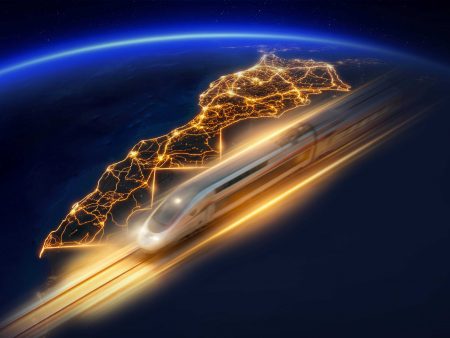
- Morocco commissioned the first high-speed railway line on the African continent, linking Tangier and Casablanca in just over two hours.
Morocco is developing an efficient transport network to support growth, strengthen its integration into global value chains and improve mobility for its population.
The country has adopted an integrated approach to the development of its road, highway, port, rail and airport networks, supported in recent decades by the African Development Bank Group.
“Next-generation infrastructure is reshaping Morocco: it brings territories closer together, facilitates mobility and strengthens its logistical performance. From roads to ports, from railways to airports, each investment contributes to building a more integrated, competitive and globally open economy, driven by a strategic partnership with the Kingdom,” said the head of the African Development Bank in Morocco, Achraf Tarsim.
The development of Morocco’s rural road network has played a fundamental role in opening up territories. The African Development Bank Group supported the two phases of the National Rural Roads Programme, totalling €90 million and enabling the construction of more than 26,000 kilometres of rural roads. The development of this network has helped reduce isolation across more than 80% of rural territory.
The rural road network has facilitated access to basic services, stimulated local agricultural and commercial activities, and improved mobility for millions of inhabitants.
Morocco has also implemented highway infrastructure aimed at strengthening inter-regional mobility and supporting trade.
The Marrakech–Agadir highway has reduced travel time between the two cities by approximately two hours, while also boosting economic, agricultural and tourism-related trade. Supported by the African Development Bank with more than €118 million, the project included the replanting of approximately 221,000 argan trees across 920 hectares.
The Guercif–Nador highway, currently under construction, will connect the eastern region to the national network and the future Nador West Med port complex, facilitating industrial and commercial exchanges and improving the movement of people and goods. The Bank is contributing €229 million to the financing of this project.
Since 2015, the African Development Bank Group has mobilised around €290 million for the construction of the Nador West Med port complex, with the ambition of positioning Morocco on the main routes of African and international trade.
The future maritime hub will contribute to optimising logistics chains between North Africa and West Africa, while supporting the implementation of the African Continental Free Trade Area.
Within this context, the creation of the Bétoya industrial zone, also financed by the African Development Bank Group, will reinforce the economic attractiveness of the eastern region through the development of industrial and logistics value chains.
Morocco has also begun an ambitious modernisation of its airport infrastructure to consolidate its position as a regional hub between Africa, Europe and the Middle East.
The African Development Bank Group mobilised €240 million to finance the third airport programme, aimed at supporting the modernisation of the Kingdom’s main airport platforms.
The capacity of Marrakech-Menara Airport increased from six million to approximately nine million passengers per year, while Fez-Saïss Airport saw its capacity quintuple, reaching around 2.5 million passengers and contributing to the economic and tourism development of the Fez-Meknes region.
In Rabat, the African Development Bank Group has provided financing of more than €109 million to support the expansion and modernisation of the airport in order to meet estimated annual growth of 6% in air traffic. This project will quadruple passenger and cargo processing capacity, strengthen the competitiveness of the Rabat-Salé economic zone and generate hundreds of direct jobs.
The modernisation of air traffic control in Agadir allows for the processing of up to 2,000 flights per day during peak activity, representing an increase of approximately 30% in operational capacity. It also generates environmental benefits, with a reduction of 27,000 tonnes of CO₂ per year and savings that can reach 176,000 tonnes of kerosene.
Funding of €270 million was also approved for 2025 to modernise the airports of Marrakech, Agadir, Tangier and Fez, including the modernisation of navigation systems, the digitisation of operations and the strengthening of security measures.
The Moroccan railway network has transformed, supported by the African Development Bank Group through financing of approximately €300 million for the National Railway Office.
The programme strengthened rail capacity on the Tangier–Marrakech axis through the creation of new lines, the modernisation of signalling systems and the construction of large-scale infrastructure, including Casa Port station.
The doubling and tripling of several strategic sections, as well as the creation of a centralised traffic management command, improved capacity, safety and service regularity. This resulted in a significant increase in passenger and freight traffic, with the number of freight trains in daily circulation doubling.
These investments supported the transformation of Morocco’s railway network, illustrated by the commissioning of the first high-speed line on the African continent, linking Tangier to Casablanca in just over two hours.