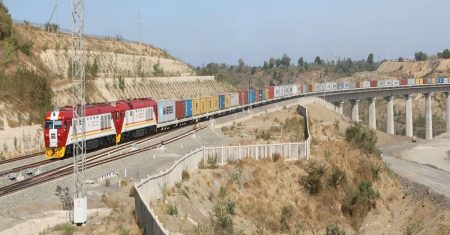
In a media release from Trade Mark Africa, it has been announced that the governments of Djibouti, Ethiopia, South Sudan and Uganda have formally agreed to establish the Djibouti-Ethiopia-South Sudan-Uganda DESSU Corridor Authority.
Signed at a ministerial session in Djibouti, the accord sets in motion a regional framework for coordinating trade, transport and logistics across the four nations. This will advance the shared vision of an integrated, efficient and sustainable connectivity in the Horn of Africa.
The DESSU Corridor will link the Port of Djibouti with landlocked South Sudan and Uganda via Ethiopia, offering new and efficient access to global markets. The newly created authority DESSU Corridor Authority will oversee planning, investment, operations and monitoring of corridor infrastructure, with a mandate to reducing transit times and costs through digital, smart logistics systems. DESSU is one of the newest corridors in the region to be formalised by an inter-state agreement. This initiative builds on solid achievements already underway.
The Djibouti-Ethiopia segment has benefited from €32 million in investments financed by the EU delegated to Agence Française de Développement under the Action Promoting regional integration in the Horn of Africa through development of the Djibouti corridor. The Action has been implemented by TradeMark Africa and is upgrading both physical and digital infrastructure along the Djibouti-Ethiopia Corridor to reduce transit time by 50%. These concrete developments demonstrate the region’s capacity to translate policy into practice, creating more predictable, transparent, and efficient trading systems. The establishment of the DESSU Corridor Authority will consolidate these achievements and serve as the institutional foundation for future corridor expansion.
While current EU support is focused on the Djibouti-Ethiopia segment, the DESSU Corridor Authority provides the platform through which the regional vision can be extended. Planned investments in roads, dry ports, and multimodal transport links between Ethiopia, South Sudan, and Uganda will build on the systems and lessons already operational between Djibouti and Ethiopia, ensuring the next phases of development follow a harmonised, regionally coherent model.
Officials from all four governments affirmed that the introduction of a binding institution marks a shift from bilateral cooperation to unified institutional governance.
The Ministers agreed that DESSU Corridor Authority will begin operations in early 2026, with immediate priorities including the establishment of a secretariat, operational protocols and a legal framework for corridor management and performance monitoring.
The DESSU Corridor Authority comes at a time when South Sudan is seeking to diversify its oil export transit routes, and has signed a complementary agreement with Djibouti to develop river and dry ports along the White Nile and is constructing a road linking Paloich South Sudan to Pagak Ethiopia. Together, these efforts position the region as an emerging gateway for continental trade.
Speaking at the signing ceremony, Hon. Hassan Houmed Ibrahim, Minister of Infrastructure and Equipment, Djibouti, said:
“This Agreement moves us from aspiration to implementation. For Ethiopia and our neighbours, it is about reducing the cost of doing business and building systems that make regional trade predictable, digital, and sustainable.”
Hon. Alemu Sime, Minister of Transport and Logistics, Ethiopia added:
“Today, we mark a historic step towards Africa’s long-held aspiration for seamless connectivity. The DESSU Corridor Authority will ensure that goods and people move faster, safer, and more efficiently across our borders, making the region a competitive gateway for continental trade.”
Hon. Madut Biar Yel, Minister of Transport, South Sudan, emphasised the corridor’s socio-economic dividends:
“By harmonising infrastructure and policy frameworks, this corridor will open new markets for South Sudan’s goods, create jobs, and strengthen regional supply chains that benefit communities across borders.”
Hon. Katumba Wamala, Minister of Works and Transport, Uganda, noted:
“Our commitment is to turn the DESSU Corridor into a model of efficiency. The establishment of the Authority ensures long-term cooperation and governance that will accelerate our regional competitiveness under the AfCFTA.”
Mr Eugene Torero, Regional Director, Horn of Africa, TradeMark Africa, remarked:
“The DESSU Corridor Authority embodies a regional vision that TradeMark Africa has long championed, one where legal frameworks, infrastructure, and digital systems converge to make trade faster, cheaper, and fairer. The signing today signals the region’s readiness to move from fragmented investments to an integrated, data-driven trade ecosystem.”
The signing ceremony took place in the presence of high-level dignitaries, including H.E. Ms Denisa-Elena Ionete, Ambassador of the European Union to Djibouti, and Eric de Guerpel, Director of the French Development Agency AFD in Djibouti, thereby demonstrating these institutions’ support to the establishment of the Corridor Authority.