AfDB Directs Sierra Leone Transport Support to Road Connectivity to 2030

Transport remains the largest part of the AfDB's Sierra Leone portfolio, and the new strategy directs that support to roads and regional road links. Rail appears only among the subsectors in which the Bank states deficiencies exist.

The transport results the Bank expects over the period rest on the MRU Phase III and IV road projects, and the next new operation is the Matotoka-Yele-Bo road, with identification scheduled for the third quarter of 2026 ahead of an indicative 2027 approval.


  • The African Development Bank will focus its transport support in Sierra Leone between 2025 and 2030 on national and regional road networks.
  • The strategy states that deficiencies exist in all four transport subsectors: roads, railway, air transport and ports.
  • Transport accounts for 41% of the Bank's active Sierra Leone portfolio of UA134 million (US$181.8 million).
  • Results are expected mainly from the MRU Road Development and Transport Facilitation projects, Phases III and IV.
  • The Bank targets a cut in travel time between Kailahun and Koindu from 1 hour 30 minutes to 40 minutes.
  • The upgrading of the Matotoka-Yele-Bo road, at UA20 million, is the only new transport operation in the 2025 to 2027 indicative programme.

The African Development Bank (AfDB) will concentrate its transport support in Sierra Leone on upgrading national and regional road networks between 2025 and 2030, according to the Bank's Country Strategy Paper (CSP) for the period, published on 18 September 2026.

The strategy states that deficiencies exist in transport infrastructure and transport services in all four subsectors: roads, railway, air transport and ports. The national core road network is estimated at 11,555km, of which 8,555km is functionally classified as primary, secondary and feeder roads and 3,000km as local and township roads, and it carries over 80% of domestic traffic. The Bank reports that the 465km of the Trans West African highway connecting Sierra Leone with Guinea and Liberia has been upgraded to ECOWAS standards, and it identifies insufficient fuel levy to cover maintenance of the expanding network among the challenges facing the road subsector.

Transport is one of three sectors, alongside energy and water and sanitation, under the strategy's first priority area, developing sustainable infrastructure for private sector development. It already holds the largest share of the Bank's active portfolio in the country, accounting for 41% of commitments totalling UA134 million (US$181.8 million) as of June 2025.

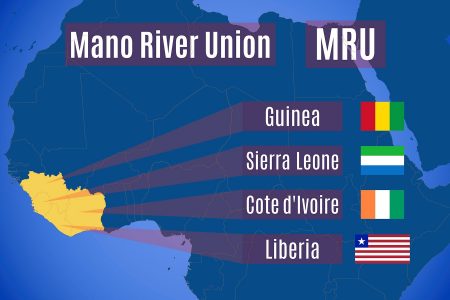
According to the strategy, transport interventions will mainly focus on connecting communities to markets within the country and across borders, and will aim to promote regional integration by addressing bottlenecks to trade and investment within the Mano River Union (MRU) and the ECOWAS region. Operations are to include capacity development components, including technical and vocational education and training (TVET) for young people and women along project corridors.

The Bank expects results in the sector during the strategy period to come mainly from the MRU Road Development and Transport Facilitation projects, Phases III and IV, which the document describes as both in early stages of implementation. Its targets are to cut travel time between Kailahun and Koindu from 1 hour 30 minutes to 40 minutes and to reduce vehicle operating cost "from USD 0.52 cents/km to 0.39 cents/km". Phase III carries a dedicated component on structured training for the project implementation unit, while Phase IV provides for consultancy services to develop long-term funding strategies for road maintenance.

One new transport operation appears in the Bank's indicative operations programme for 2025 to 2027: the upgrading of the Matotoka-Yele-Bo road, at UA20 million from the African Development Fund, with an indicative approval year of 2027 and the Islamic Development Bank listed as a potential co-financier. Identification of the project is scheduled for the third quarter of 2026. The programme as a whole comprises four sovereign operations totalling UA75 million (US$99 million).

Related News Articles