AUDA-NEPAD Launches First Continental Programme Dedicated to Africa’s Island Economies

Africa’s island economies control a combined exclusive economic zone exceeding five million square kilometres, yet the seven countries remain disconnected from one another by direct maritime services. A continental framework focused on integrated maritime and air corridors could improve connectivity, strengthen trade links and support access to larger African markets.

The programme also connects transport infrastructure with industrialisation, digital systems, climate resilience, skills development and project financing. Its 2026–2031 roadmap provides a coordinated basis for developing projects that can support AfCFTA integration and increase the value retained from island economies’ ocean-based resources.


  • The programme covers seven African island economies.
  • Participating countries are Cabo Verde, the Comoros, Guinea-Bissau, Madagascar, Mauritius, São Tomé and Príncipe and Seychelles.
  • Their combined exclusive economic zone exceeds five million square kilometres.
  • The programme is structured around six development pillars.
  • Implementation will follow a roadmap covering 2026 to 2031.
  • The programme is being advanced in partnership with the Republic of Korea.
  • The African Development Bank, Regional Economic Communities and Indian Ocean Commission are also involved.


AUDA-NEPAD Launches First Continental Programme Dedicated to Africa’s Island Economies
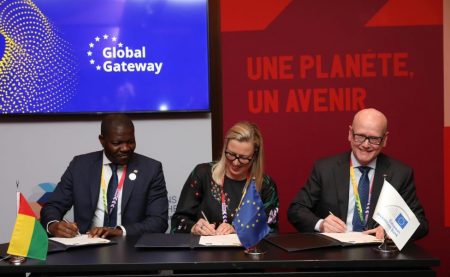
AUDA-NEPAD launched the Programme for African Developing Island Economies during the Ministerial Segment of the Specialised Technical Committee on Trade, Industry and Minerals in Abidjan. Supplied by: © AUDA-NEPAD

Cabo Verde, the Comoros, Guinea-Bissau, Madagascar, Mauritius, São Tomé and Príncipe and Seychelles have joined a country-owned framework focused on industrialisation, digitalisation, corridors, artificial intelligence and the knowledge economy, in partnership with the Republic of Korea.

The African Union Development Agency has launched a dedicated programme for Africa’s seven island economies, establishing the first continental framework specifically designed around the challenges facing African small island states.

The programme was launched during the Ministerial Segment of the Specialized Technical Committee on Trade, Industry and Minerals in Abidjan.

Together, the seven island economies have a combined exclusive economic zone of more than five million square kilometres, an ocean territory larger than the landmass of the European Union. Despite this scale, none of the seven countries has direct maritime connectivity with the others.

The countries also face common constraints, including small domestic markets, high exposure to climate shocks and limited capacity to add value to ocean-based industries before exporting their products.

The AUDA-NEPAD Programme for African Developing Island Economies is intended to address these constraints by grouping the seven countries under a three-tier typology reflecting their different development positions.

Support will be organised around six pillars covering the blue economy and ocean stewardship, climate resilience and adaptation, sustainable energy and water, connectivity and African Continental Free Trade Area integration, youth employment and skills, and digital transformation.

The programme will be implemented through a roadmap covering the period from 2026 to 2031.

“Africa’s island economies are not at the margin of our transformation; they are at its frontier. This Programme meets them where they are, with a framework they own, and with the accelerators that turn distance and small scale into advantage,” said AUDA-NEPAD Chief Executive Officer Nardos Bekele-Thomas.

The programme does not rely on a single economic sector. Its framework combines industrialisation suited to island resources, integrated maritime and air corridors, digital public infrastructure, artificial intelligence and automation, and investment in the knowledge economy.

Officials believe that bringing these elements together could help island states turn geographical distance and small economic scale into advantages rather than constraints.

The framework was developed during a Senior Officials Consultative Meeting held earlier during the committee week. Representatives of the seven economies reviewed the programme’s design, confirmed national focal points and validated recommendations ahead of the Ministerial Segment.

Ministers subsequently adopted a Ministerial Communiqué recording their commitment to the programme and inviting support from development partners.

The programme is being advanced in partnership with the Republic of Korea, with the involvement of the African Development Bank, the Regional Economic Communities and the Indian Ocean Commission.

It was launched alongside the Africa Green Transition PPP Fund, with several island economies already presenting green-transition projects of the type the fund is intended to finance.